
NGBF Peace Committee asks FRGN to withdraw October 23 order
The village headmen’s peace body called the directive “immature and unwarranted” and said non-Naga residents are part of Nagaland’s fabric.
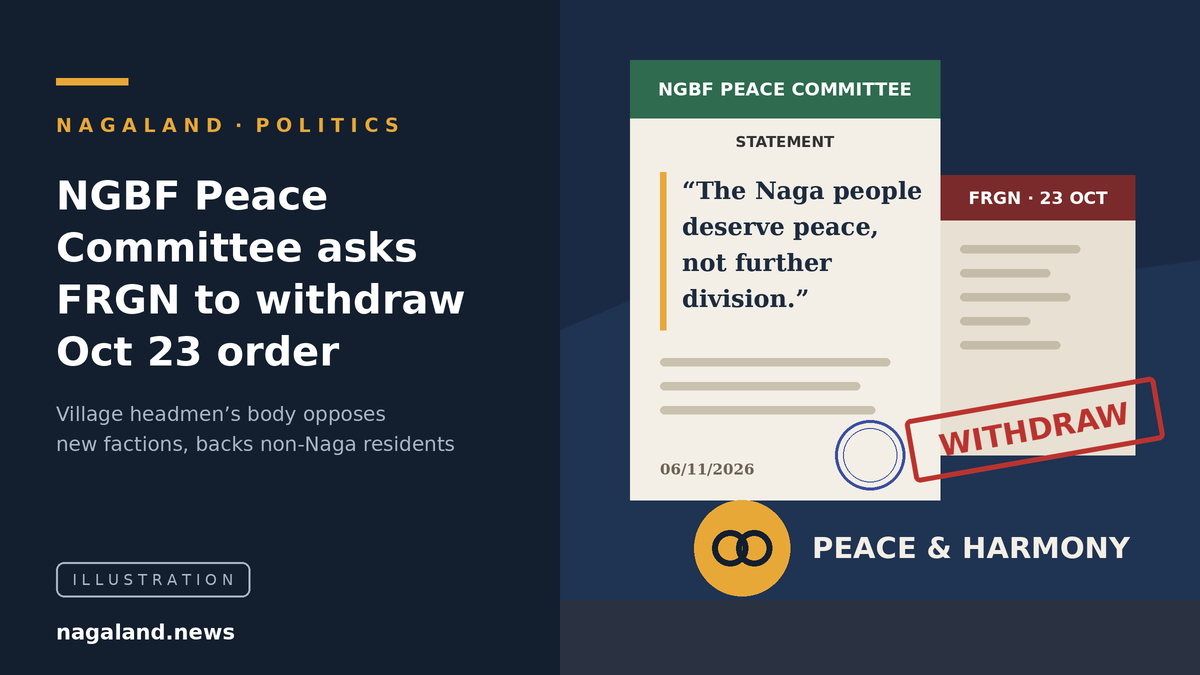
KOHIMA – The Peace Committee of the Nagaland Gaonbura Federation (NGBF PC) has rejected the 23 October directive of the newly formed NSCN/FRGN and asked the group to formally withdraw it, saying such pronouncements threaten peace and the safety of non-Naga residents of the state.
In a statement issued on Friday, 6 November 2026, and reported by The Morung Express and Nagaland Post, the committee of village headmen described the FRGN’s statement as “immature and unwarranted” and said it could cause needless fear and “undermine the prevailing atmosphere of peace and harmony in Nagaland.”
It asked the group to retract it “in the larger interest of peace and public welfare.”
The statement, as reported, did not name the office-bearers who issued it. Nagaland.News was unable to obtain the full text independently.
‘No support for new factions’
The NGBF PC said the Naga people do not back the creation of new factions or any further splintering of the Naga political movement.
Differences among leaders, it said, should be settled through dialogue rather than by breaking away. “It is more dignified to retire gracefully with one’s honour intact than to defect or establish another faction,” the committee said.
It argued that the FRGN statement neither addressed the core political issue between the Government of India and the Naga people nor the economic and social concerns facing Naga society.
The committee repeated its call for an early, “honourable and acceptable” settlement negotiated between the Centre and the two Naga negotiating groups, the NSCN (IM) and the Working Committee of the Naga National Political Groups (WC, NNPGs). Talks, it said, cannot drag on indefinitely.
“This remains the foremost concern of apex Naga tribal bodies, civil society organisations, Naga political groups and the people, including families and churches across Naga towns and villages,” the statement said.
Concern for Nagas outside the state
The NGBF PC said the FRGN directive had also alarmed Nagas living elsewhere in India, among them students, central government staff, private-sector workers, entrepreneurs and their families.
It said the statement had “sent negative shockwaves across Naga communities” and that the committee “unequivocally rejects” the position of what it called the “so-called NSCN/FRGN.”
Non-Naga residents ‘integral’ to Nagaland
In a pointed reference to the directive’s impact on traders, the committee acknowledged the role of non-Naga communities who have lived in Nagaland for generations, some since the British colonial era.
It said they had contributed widely to business, education, healthcare and development, and that many had made the state their permanent home and become “an integral part of its social and economic fabric,” despite not sharing Naga ancestry.
The NGBF PC said it “firmly opposes all dictatorial directives, intimidating pronouncements and unauthorised publications” that endanger non-Naga communities or damage long-standing ties between Nagas and non-Nagas. That “time-tested communal harmony must be protected and strengthened at all costs,” it said.
The committee urged all sides to show restraint and act responsibly.
“The Naga people deserve peace, not further division; reconciliation, not confrontation; and an honourable political solution, not endless uncertainty,” it said.
The NSCN/FRGN had not publicly responded to the NGBF PC statement at the time of publishing.
Background: the FRGN directive
The NSCN/FRGN, a group that announced itself in October, issued a press release dated 23 October calling for the closure of businesses on Sundays, backing the state’s liquor prohibition law, declaring zero tolerance for drug peddling and prostitution, and ordering non-local individuals and businesses to stop using the “Naga name, identity or representation” within 30 days. Read our original report on the directive.
The directive drew immediate pushback. The Confederation of Nagaland Chamber of Commerce and Industry (CNCCI) rejected it, as reported in our follow-up on the CNCCI response. On 27 October, the WC, NNPGs told the FRGN to rescind its order and disband within two weeks.
On 29 October, the FRGN issued a clarification saying the 30-day deadline was meant for drugs and prostitution, not shops, though it did not withdraw the directive. The Zunheboto Chamber of Commerce and Industry (ZCCI) later opposed the “purported” ultimatum and backed the CNCCI.
The NGBF, a federation of village headmen (gaonburas) across Nagaland, set up its Peace Committee to work with civil society and Naga leaders on the Naga political issue.

Aloto Naga
Aloto Naga is an Indian journalist and digital media entrepreneur based in Dimapur, Nagaland. He is the founder, editor and publisher of Nagaland.News (formerly Nagaland News Today), a digital publication covering breaking news, politics, education and community developments across Nagaland and Northeast India.
More about Aloto Naga →Related Stories
Pay no underground ‘tax’, Chümoukedima bodies tell traders
Citing reports of cadres seeking fees from construction workers, the CTYO, CCCTA and Town Council invoke the 2014…

BJP Nagaland defends SIR as voter roll revision nears end
A BJP youth leader told the Dimapur meet that the 13 crore figure counts names flagged for checks,…
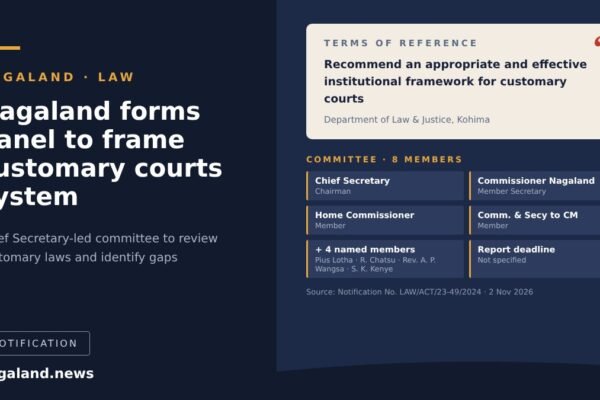
Nagaland forms panel to frame customary courts system
An eight-member committee headed by Chief Secretary Sentiyanger Imchen will review customary laws and recommend a framework for…
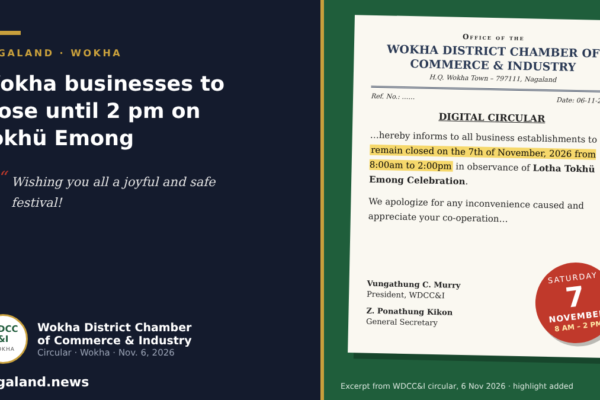
Wokha businesses to close until 2 pm on Tokhü Emong
The Wokha District Chamber of Commerce & Industry asks all business establishments to stay shut from 8 am…
Comments
No comments yet. Be the first to share your view.