
FRGN directive: CNCCI asks Nagaland government to act
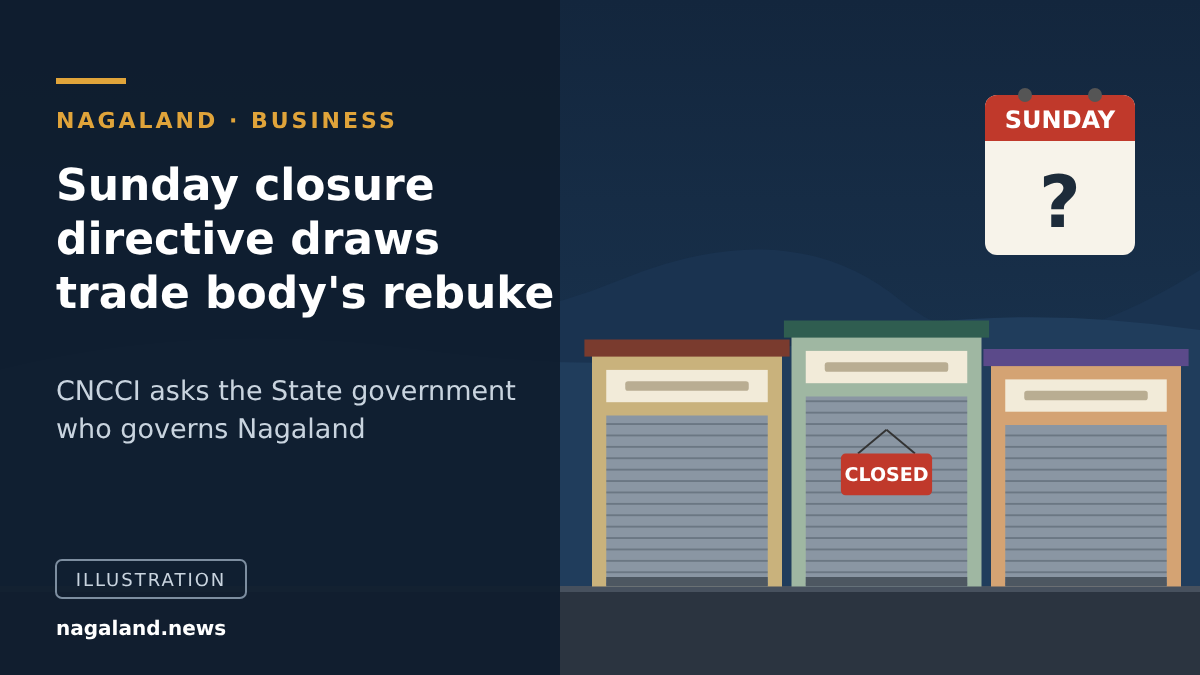
The Confederation of Nagaland Chamber of Commerce and Industry (CNCCI) has asked the Nagaland government to state publicly who governs the State, after the NSCN/FRGN directed all shops to close on Sundays and told non-Naga businesses to shut down.
In a statement reported by Nagaland Tribune on October 25, the State’s apex business body called the FRGN directive a “serious and potentially threatening development” and urged the government to investigate what it called an unauthorised diktat and take legal action against those responsible.
The Federal Republic Government of Nagaland (FRGN), the government arm of an NSCN faction, issued a four-point press release on October 23. It ordered businesses in Naga-inhabited areas to remain closed on Sundays, warned of heavy penalties for violators, and gave shops run by non-locals 30 days to close. Read our earlier report on the NSCN FRGN directive on Sunday closure and non-local shops.
Sunday worship and Sunday trading
The CNCCI said Nagaland must respect Sunday worship and be mindful of church service hours, including weekday services. But it said religious observance should be balanced against practical realities and should not be used to justify a blanket ban on trading.
It noted that businesses open on Sundays in the United States and other Christian-majority countries, subject to local laws, even though it was American missionaries who brought Christianity to the Naga people.
Giving workers one day of rest a week, the body said, is not the same as banning Sunday business. Trading hours should be set by business needs, not by “emotional or moral policing”, it said. Also Read NSCN/FRGN Declares Kikheto Chishi President, Richard Naga Chakhesang Vice-Presiden
‘Naga First’ but not exclusion
The CNCCI said it has long promoted Naga businesses and youth entrepreneurship under its motto, “Naga First“. It said hundreds of non-Naga business owners had already closed their shops and moved away of their own accord.
However, it said promoting Naga enterprise cannot mean excluding other communities from lawful economic activity. It said it would oppose coercion, discrimination and any attempt to undermine legitimate businesses.
Naga businesses, it added, have grown over the past decade to supply goods and services across India and abroad, which it said showed that progress comes from enterprise and wider trade, not isolation.
Warning on investment and communal tension
The body warned that forcing businesses to close on ethnic grounds, even in the name of protecting Naga enterprise, could set Nagaland’s economy back “by centuries”. No economy can work in isolation, it said, pointing to China’s growth after it opened its economy to outside investment, technology and markets.
Such directives could weaken investor confidence, create communal tension and undermine the State’s economic hopes, the CNCCI said.
The statement also reminded the FRGN that the Naga public had mandated the Naga national movement to pursue the Naga political issue, and urged it to stay focused on that instead of matters beyond its mandate.
Demands on the State government
The CNCCI asked the government to:
- say publicly whether the elected State government or the FRGN governs Nagaland;
- explain the legal status of the directive and what action has been taken;
- investigate the directive and act against those responsible under the law.
The body said it did not want to inconvenience the public during the festive season, but warned it would be “compelled to take its own course of action” if the government did not respond promptly. It did not say what that action would be.
What happens next
The FRGN directive is not issued under any State or central law. As of October 26, Nagaland.News had not seen a public response from the Nagaland government or the FRGN to the CNCCI statement. The 30-day deadline set for non-local shops in the directive falls in late November.
This report is based on a CNCCI statement as reported by Nagaland Tribune.
Related Stories
Mt Horeb drone strike: NSCN breakaway faction blames India
DIMAPUR – A breakaway Naga armed group on Saturday accused the Indian Army of carrying out a pre-dawn…
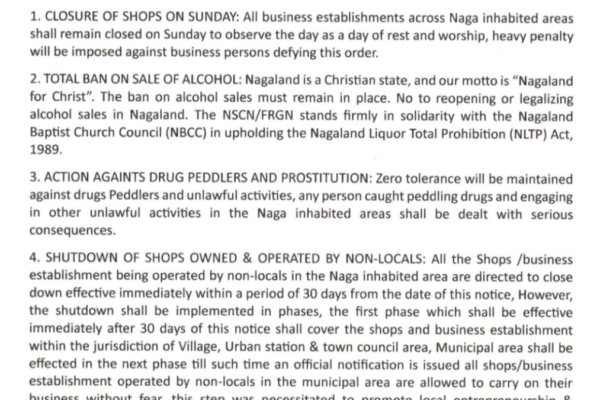
NSCN FRGN Directive: Sunday Shop Closure, Liquor Ban and 30 Day Deadline for Non Local Shops
Dimapur, October 23, 2026: In a fresh NSCN FRGN directive, the Ministry of Information and Publicity (MIP) of…
Angami Public Organisation Sets Deadlines to Restrict Employment, Services and Rental to ‘Illegal Immigrants’
The Angami Public Organisation (APO) has announced a series of resolutions concerning people it identifies as “illegal immigrants,”…

Kohima to Hold Special Camps for SIR 2026 on October 9
October 7, 2026: SIR 2026 (Special Intensive Revision) will see special camps conducted at polling stations across Kohima…