
Nagaland forms panel to frame customary courts system
An eight-member committee headed by Chief Secretary Sentiyanger Imchen will review customary laws and recommend a framework for customary courts.
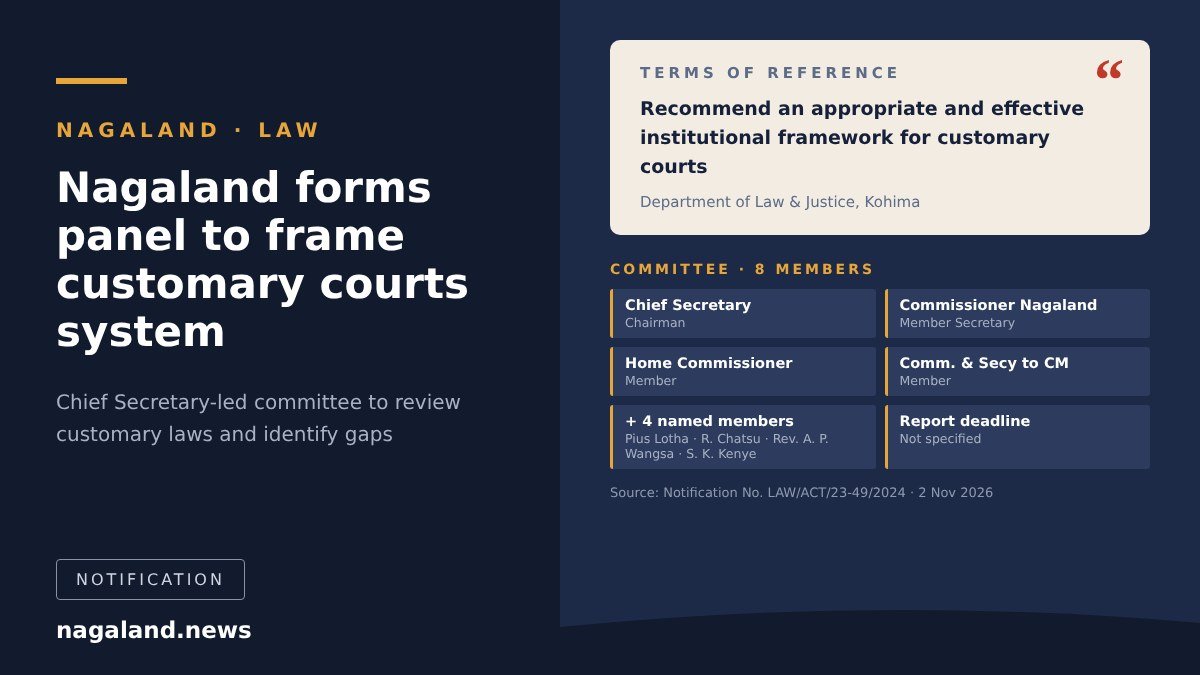
KOHIMA – The Nagaland government has set up an eight-member committee, headed by Chief Secretary Sentiyanger Imchen, to examine the laws that govern Nagaland customary courts and recommend “a proper institutional framework” for them.
The committee was constituted in the name of the Governor of Nagaland through a Department of Law & Justice notification, No. LAW/ACT/23-49/2024, dated November 2, 2026, and signed by Imchen.
According to its terms of reference, the committee may examine “the existing legal and institutional framework relating to customary laws and customary courts in the State” and “identify the gaps and challenges.”
It is also to recommend measures for “an appropriate and effective institutional framework for customary courts, while duly safeguarding the constitutional and customary rights of the indigenous people of Nagaland.”
The notification does not set a deadline for the committee to submit its report.
Who is on the committee
The committee has four senior officials and four other members:
- Chief Secretary – Chairman
- Commissioner, Nagaland – Member Secretary
- Home Commissioner – Member
- Commissioner & Secretary to the Chief Minister – Member
- Pius Lotha – Member
- Razouvotuo Chatsu – Member
- Rev. A. Peihwang Wangsa – Member
- S. K. Kenye – Member
The notification names the four non-official members but does not give their designations or say whom they represent.
Copies were sent to the Commissioner & Secretary to the Chief Minister, the Joint Secretary in the Chief Secretary’s office and all committee members. The copy was endorsed by the Deputy Legal Remembrancer & Deputy Secretary to the Government of Nagaland.
Why customary courts matter in Nagaland
Customary law has special constitutional protection in Nagaland. Under Article 371A of the Constitution, no Act of Parliament on Naga customary law and procedure, or on the “administration of civil and criminal justice involving decisions according to Naga customary law,” applies to the state unless the Nagaland Legislative Assembly decides so by a resolution.
The same protection covers the religious and social practices of the Nagas and the ownership and transfer of land and its resources.
In practice, most disputes between tribal members are still settled through village councils, gaon buras, dobashis and the courts of deputy commissioners and their assistants. That system rests on the Rules for the Administration of Justice and Police in Nagaland, which date back to 1937. Also Read NGBF Peace Committee asks FRGN to withdraw October 23 order
A reform that has been years in the making
The new committee comes after several attempts to put customary courts on a firmer legal footing.
A 1984 amendment to the Rules added Chapter IVA, which provided for customary courts, but its provisions were not brought into force. In March 2025, the state’s Additional Advocate General told the Kohima Bench of the Gauhati High Court that the government had begun the process to operationalise them, The Morung Express reported.
The same month, on March 7, 2025, the Assembly passed the Rules for Administration of Justice and Police in Nagaland (Fifth Amendment) Bill, 2025. It received the Governor’s assent on April 12 and was published in the Nagaland Gazette on April 25, 2025, according to Eastern Mirror.
The Act replaced Chapter IVA with a three-tier system of village courts, subordinate district customary courts and district customary courts, with civil and criminal powers over disputes among members of Scheduled Tribes.
On May 21, 2025, a division bench of Justice Kakheto Sema and Justice Mitali Thakuria gave the state six weeks to constitute the courts, in the case of Kevizathi Sesa v. State of Nagaland, LiveLaw reported.
The Act also drew opposition. In a representation to Chief Minister Neiphiu Rio, who holds the Law & Justice portfolio, the Nagaland Bar Association asked the government to keep the amendment in abeyance and review it, EastMojo reported in June 2025.
The association argued that the new courts would be statutory bodies staffed by government appointees, with no roots in Naga customs. It also objected to the government’s role in forming village courts and removing their members, and to the courts applying the Code of Civil Procedure and the Bharatiya Nagarik Suraksha Sanhita.
Earlier, in January 2025, Deputy Chief Minister T. R. Zeliang had proposed a three-tier customary court system built around dobashis at a Nagaland Dobashi Association conference in Mokokchung, Mokokchung Times reported.
The November 2 notification does not refer to the 2025 Act, the High Court case or the Bar Association’s objections. Nagaland.News could not independently confirm whether any courts under the 2025 Act have been constituted.

Aloto Naga
Aloto Naga is an Indian journalist and digital media entrepreneur based in Dimapur, Nagaland. He is the founder, editor and publisher of Nagaland.News (formerly Nagaland News Today), a digital publication covering breaking news, politics, education and community developments across Nagaland and Northeast India.
More about Aloto Naga →Related Stories
Pay no underground ‘tax’, Chümoukedima bodies tell traders
Citing reports of cadres seeking fees from construction workers, the CTYO, CCCTA and Town Council invoke the 2014…

BJP Nagaland defends SIR as voter roll revision nears end
A BJP youth leader told the Dimapur meet that the 13 crore figure counts names flagged for checks,…
NGBF Peace Committee asks FRGN to withdraw October 23 order
The village headmen’s peace body called the directive “immature and unwarranted” and said non-Naga residents are part of…
Wokha businesses to close until 2 pm on Tokhü Emong
The Wokha District Chamber of Commerce & Industry asks all business establishments to stay shut from 8 am…
Comments
No comments yet. Be the first to share your view.