
Nagaland forest officers must serve in remote districts to win promotion
Officers from Deputy Ranger Officer to DCF must now serve a full term in remote Category C districts to qualify for promotion, the new policy says.
KOHIMA – Forest officers in Nagaland will no longer be eligible for promotion unless they have served at least one full term in the state’s most remote districts, under the new Nagaland forest transfer policy notified by the state government this month.
The Nagaland Forest Department Officers’ Transfer Policy, 2026, was notified by the Department of Environment, Forests and Climate Change (DEFCC) under notification No. FOR/ESTT/SFS-14/04/2026. It is issued in the name of the Governor of Nagaland and signed by Y. Kikheto Sema, IAS, Principal Secretary and Development Commissioner.
The policy says it aims to “ensure transparency, objectivity, and fairness in transfers and postings while maintaining operational efficiency in forest management across the State.” It supersedes all previous orders, circulars and guidelines on the subject and takes effect from the date of notification.
The dated line on the copy seen by Nagaland.News reads only “November 2026”, with the day of the month left blank. The copy was countersigned on 2 November 2026 by Dr Y. Atsase Thongtsar, Secretary to the Government of Nagaland.
Who the policy covers
The policy applies to all officers of the Nagaland Forest Department from the rank of Deputy Ranger Officer up to and including Deputy Conservator of Forests (DCF) or Divisional Forest Officer (DFO).
Indian Forest Service (IFS) officers posted in Nagaland up to the rank of DCF/DFO will also be governed by it “to the extent specified”. This is in addition to, and not in derogation of, the All India Services (Cadre) Rules, 1954 and other IFS service rules, the notification says. Also Read Nagaland brings GST amendments into force from October 1, 2025
Three categories of districts
For transfers and postings, the policy divides the state into three categories based on accessibility, infrastructure, hardship and remoteness:
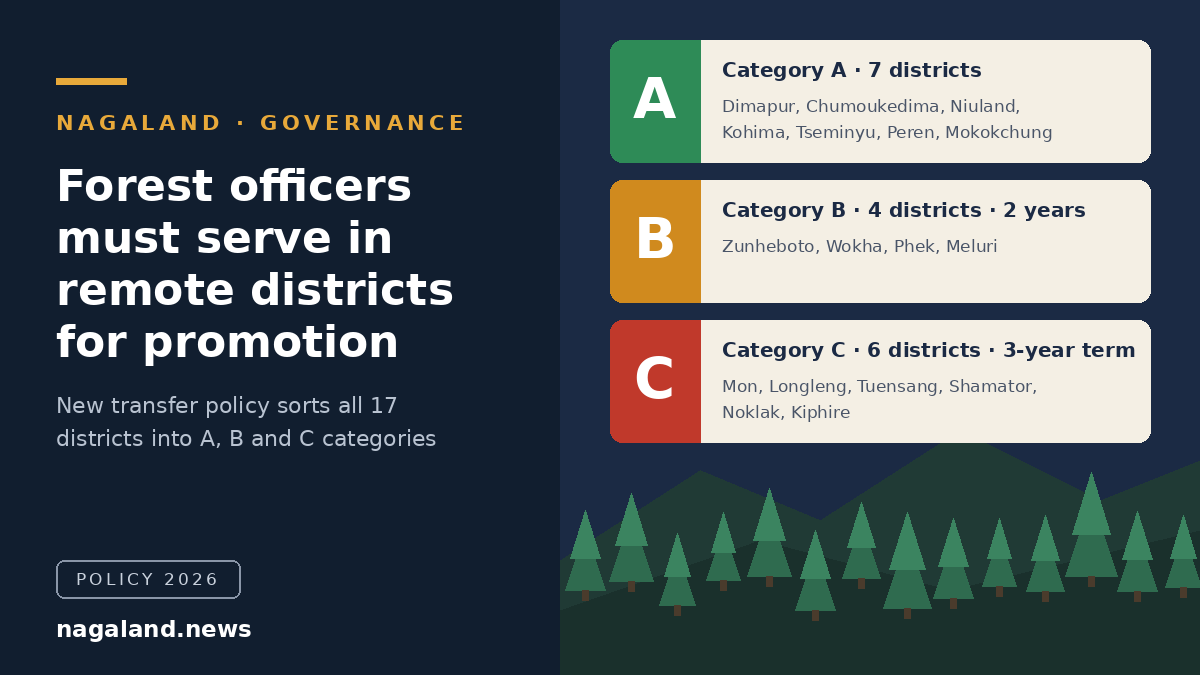
- Category A (“relatively well-connected, accessible”, with standard amenities): Dimapur, Chumoukedima, Niuland, Kohima, Tseminyu, Peren and Mokokchung.
- Category B (“moderately accessible with limited amenities”): Zunheboto, Wokha, Phek and Meluri.
- Category C (“geographically remote, difficult to access”, with “significant logistical and operational challenges”): Mon, Longleng, Tuensang, Shamator, Noklak and Kiphire.
Three to five years at each station
The standard tenure at any station is a minimum of three years and a maximum of five years, which the policy calls “one full term”.
Officers will ordinarily not be moved before three years. The exceptions are exigency of public service or administrative necessity, with reasons recorded in writing; disciplinary proceedings; serious medical grounds certified by a competent authority; and other exceptional circumstances decided by the competent authority.
Officers transferred on personal grounds before completing the minimum tenure will not get Transfer Allowance, and the move will be treated as being at their own cost.
Remote postings tied to promotion
Every officer covered by the policy must serve at least one full term, a minimum of three years, in a Category C posting during their career. In addition, officers must serve at least two years in a Category B posting to be eligible for their next promotion.
An officer will be eligible for promotion to the next higher rank only after satisfactorily completing either:
- at least one term (minimum three years) in Category C and at least two years in Category B; or
- five years of continuous service in Category C.
An officer who has not completed the mandatory Category C service will not be eligible for promotion. The provision “is intended to ensure that postings in Category C are not avoided by officers,” the notification says.
The policy also offers incentives. Officers who have served more than five years continuously in Category C, or at least three years in Category C plus two years in Category B without an intervening Category A posting, may request a Category A posting. The department will consider such requests on priority “in recognition of sustained service.”
An officer who completes the maximum five-year term in Category C may also seek a transfer to Category A or B. The request will be processed on priority, with preference in the choice of station, subject to a suitable vacancy.
IFS induction seniority protected
The Category B and C requirements will not affect the inter se seniority of State Forest Service (SFS) officers for induction into the IFS, the policy says. That seniority will continue to be decided strictly under the applicable service rules, regulations, guidelines and orders, “and not by reference to the posting requirements or promotion-related eligibility conditions” in the policy.
No long stints in home districts
The policy restricts officers from serving long in their own home districts. Where an officer’s Category B or C posting is in their home district:
- an officer in Category B will ordinarily be transferred to Category C or A after completing the three-to-five-year term;
- an officer in Category C will ordinarily be transferred to Category A or B after the term; or
- an officer willing to keep serving in Category C will be posted to a different Category C district.
Serving in home territory for extended periods “can compromise the impartiality of forest governance,” the notification says.
IFS officers to start in Category C
Every IFS officer posted in Nagaland as a Deputy Conservator of Forests “should start their tenure in cadre post in a Category C”, the policy says. When the competent authority issues such an order, the officer must accept and join the Category C or B posting.
IFS officers of DCF rank may go on central deputation to Government of India ministries, departments or central public sector undertakings; inter-cadre deputation to another state cadre; or intra-state deputation to another department, corporation or authority in Nagaland.
All such deputations need a No Objection Certificate (NOC) from the Government of Nagaland under the All India Services (Cadre) Rules, 1954. While considering the NOC, the government may check whether the officer has served in Category B or C. On returning from deputation, the officer may be sent to Category B or C to complete the mandatory posting.
Rotation and an annual transfer season
Officers will, as far as possible, be rotated across territorial, wildlife and functional or headquarters divisions. The policy says this builds professional versatility and “reduces dependence on posting in specific divisions.”
The Office of the Principal Chief Conservator of Forests and Head of Forest Force (PCCF and HoFF) will invite applications for general transfers every year from January to March. Routine transfers will ordinarily be carried out once a year in a designated transfer season, preferably between November and January, “to minimise disruption to field operations.” Ad hoc or out-of-season transfers will be discouraged.
Before each season, officers completing their tenure will be identified, vacancies will be mapped across all categories, and the Administration Wing will prepare a draft transfer list for approval by the competent authority. Officers will get a reasonable notice period before joining a new station. Also Read CCYO Gives Nagaland Government 7 Day Ultimatum Over Vezhoto Hesuh Case
The PCCF’s office will also maintain group-wise Consolidated Posting Registers for all officers covered by the policy. These will serve as the authoritative record for planning each transfer season.
Relaxation allowed
The policy states that the guidelines do not give any officer a right to a specific transfer or posting. Relaxation may be allowed in exceptional cases of extreme hardship or in the interest of public service, as the competent authority sees fit.
The government has reserved the right to modify, amend or revoke any provision at any time in public interest. Matters not covered by the policy will be governed by the general rules and orders of the Government of Nagaland on service conditions and transfers.
Copies of the notification have been sent to the Commissioner and Secretary to the Governor at Lok Bhavan, the Principal Secretary to the Chief Minister, the Principal Private Secretary to the Minister of Environment, Forest and Climate Change, the Joint Secretary to the Chief Secretary, and the PCCF and HoFF. The Director of Information and Public Relations and the Publisher of the Nagaland Gazette have been asked to publish it.

Aloto Naga
Aloto Naga is an Indian journalist and digital media entrepreneur based in Dimapur, Nagaland. He is the founder, editor and publisher of Nagaland.News (formerly Nagaland News Today), a digital publication covering breaking news, politics, education and community developments across Nagaland and Northeast India.
More about Aloto Naga →Related Stories
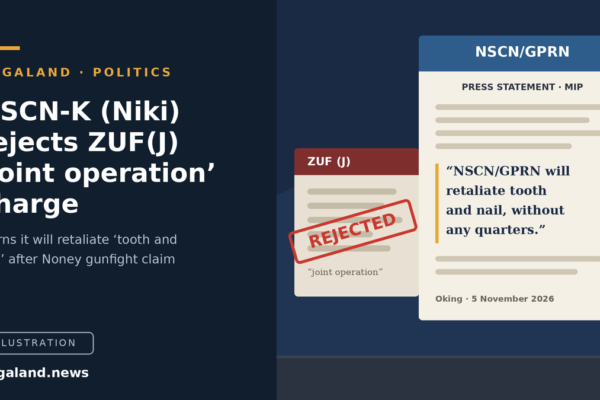
NSCN-K (Niki) rejects ZUF(J) ‘joint operation’ charge
The NSCN/GPRN- Niki warns it will retaliate "tooth and nail" if the claim, made after Wednesday's deadly Noney…
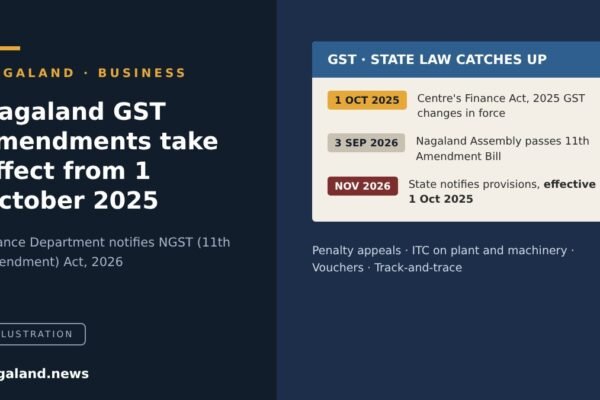
Nagaland brings GST amendments into force from October 1, 2025
The Finance Department has notified most provisions of the Nagaland GST (11th Amendment) Act, 2026 with back-dated effect,…
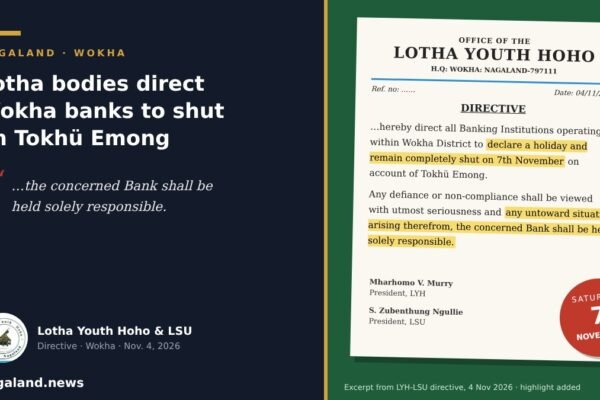
Lotha bodies direct Wokha banks to shut on Tokhü Emong
The Lotha Youth Hoho and Lotha Students' Union say banks that stay open on Nov. 7 will be…

Mokokchung groups ease CMO office shutdown for 3 days
Five civil society bodies pause the closure of the CMO office from Nov. 5 to 7 for child…
Comments
No comments yet. Be the first to share your view.