
NSCN-K says commerce curbs must not overshadow Naga cause
NSCN-K says commerce curbs must not overshadow Naga cause
The faction says the rights of non-Nagas doing lawful business must be respected, and warns against letting commercial restrictions divert the movement.
KOHIMA – The Khango-Vusshe faction of the NSCN-K has said that any regulation of commercial activity in Naga areas must be “lawful, reasonable, and justifiable, rather than arbitrary or discriminatory,” and that non-Nagas engaged in legitimate business deserve to have their rights protected.
The statement, issued on Monday, 26 October 2026, by the group’s Ministry of Information and Publicity, did not name any organisation. The group’s media in-charge told Nagaland.News by phone that it was a general appeal to the public and not a reply to any particular group. It comes days after a directive from another Naga group, the NSCN/FRGN, ordered all shops to close on Sundays and gave non-local businesses a 30-day deadline, a move the Confederation of Nagaland Chamber of Commerce and Industry (CNCCI) has opposed.
Rights of non-Naga traders
In the press release (Memo No. 02/MIP-GPRN/PR-17/2026-27), the NSCN-K said non-Nagas “who have long resided in our land and engaged in legitimate business and other lawful occupations” deserve to have their rights and interests addressed “within the framework of the law of the land.”
“The protection of Naga identity and political rights need not come at the expense of the lawful rights of others,” the statement said.
‘Control over commerce’ not the measure
The faction argued that the Naga movement should be judged by progress towards a settlement, not by economic leverage.
“The ultimate measure of our political movement should not be the extent of our control over commerce or our ability to impose restrictions, but the progress we make towards securing our political rights and achieving an acceptable solution,” it said.
It urged Nagas to keep their focus on “the larger political question, rather than being diverted by immediate commercial interests, monetary considerations, or measures that offer little contribution to our ultimate objective.” It also warned against allowing “peripheral issues, commercial restrictions, or attempts to command public attention” to overshadow the cause.
Call for unity among factions
The NSCN-K acknowledged that the Naga political movement has, over the decades, split into “numerous factions and groups,” but said the shared aim remained to preserve Naga identity, secure political rights and reach “an honorable and mutually acceptable political solution.”
The group called for energies to be directed towards “constructive political engagement” and a united effort for an early settlement. “Our people deserve more than prolonged uncertainty and the pursuit of immediate interests,” the statement said, calling for “an honorable, inclusive, and acceptable political solution for the Nagas.” Also Read NSCN FRGN Directive: Sunday Shop Closure, Liquor Ban and 30 Day Deadline for Non Local Shops
Background
The NSCN-K split into several factions after the death of its founder, S.S. Khaplang, in 2017. The Khango-Vusshe group is one of them. Several Naga political groups use the title “Government of the People’s Republic of Nagaland” (GPRN) in their communications.
The FRGN directive, issued on 23 October, also backed a ban on liquor sales. The CNCCI has publicly opposed the directive. The NSCN/FRGN had not responded to the NSCN-K statement at the time of publishing.
Related Stories
FRGN directive: CNCCI asks Nagaland government to act
The Confederation of Nagaland Chamber of Commerce and Industry (CNCCI) has asked the Nagaland government to state publicly…
Mt Horeb drone strike: NSCN breakaway faction blames India
DIMAPUR – A breakaway Naga armed group on Saturday accused the Indian Army of carrying out a pre-dawn…
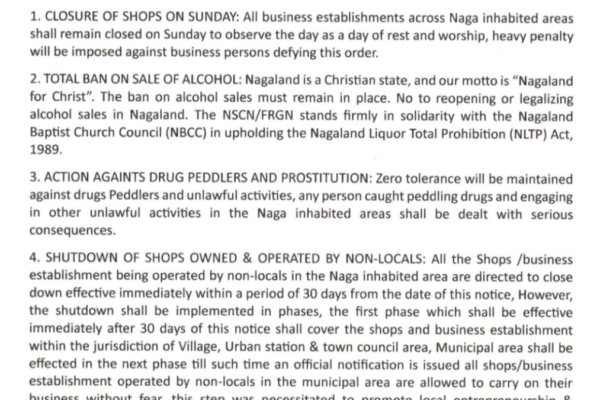
NSCN FRGN Directive: Sunday Shop Closure, Liquor Ban and 30 Day Deadline for Non Local Shops
Dimapur, October 23, 2026: In a fresh NSCN FRGN directive, the Ministry of Information and Publicity (MIP) of…

Cüze Rülho Khel Youth Organisation Condemns Alleged Sexual Assault by Taxi Driver In Kohima, Demands Swift Justice
KOHIMA, October 19, 2026: The Cüze Rülho Khel Youth Organisation, Nerhema, has condemned the alleged kidnapping, wrongful confinement,…