
Nagaland forum backs Siang Valley’s fight against mega dam
A Nagaland conservation network tells Adi villages opposing the Siang dam they are not alone, and asks the government to accept their kebangs’ no.
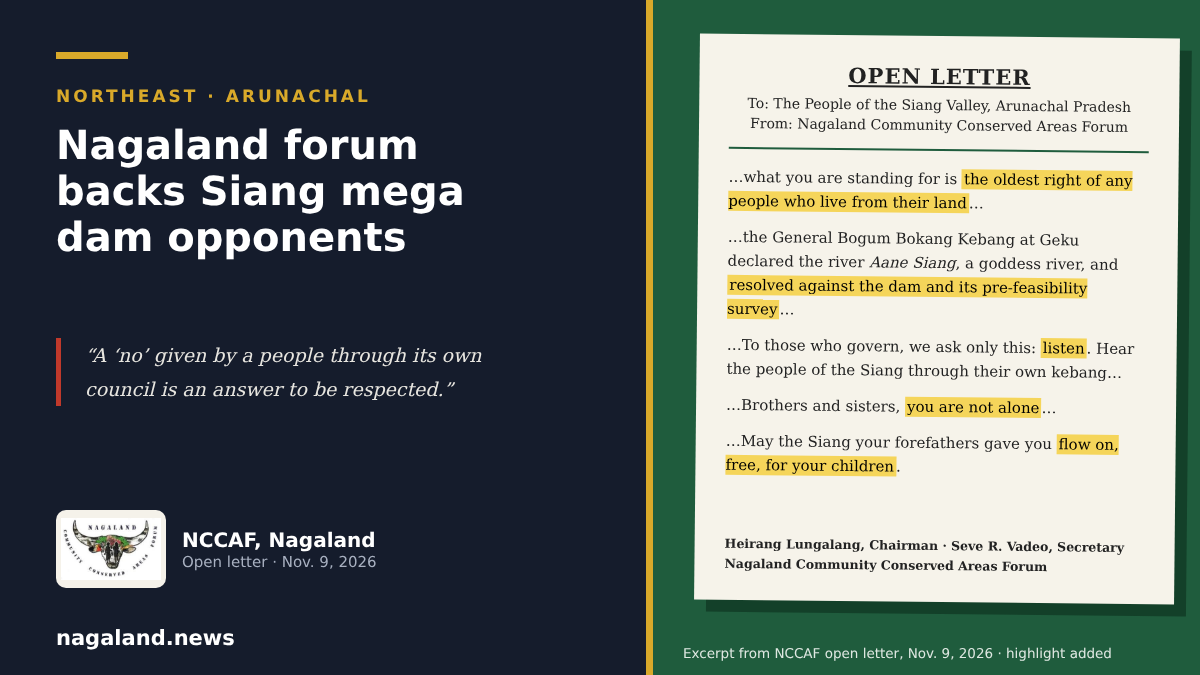
KOHIMA – A network of Nagaland’s community-protected forests has written to the people of the Siang Valley in Arunachal Pradesh, backing their resistance to the proposed Siang dam and urging the government to accept the verdict of their traditional village councils.
In an open letter dated November 9, the Nagaland Community Conserved Areas Forum (NCCAF) told Adi communities opposing the Siang Upper Multipurpose Project, and the pre-feasibility survey for it, that they were “not alone”.
“A ‘no’ given by a people through its own council is an answer to be respected, not an obstacle to be worked around,” said the letter, signed by NCCAF chairman Heirang Lungalang and secretary Seve R. Vadeo.
‘Our hearts are heavy’
Writing as “your brothers and sisters in the hills of Nagaland”, the forum said it had been watching events in the valley with heavy hearts. It spoke of mothers keeping watch on the riverbank at night, elders “punished for standing with their own villages” and young people “taken away”.
The letter said farmers in the valley had gone to their fields this harvest season under watch, unable to walk together or even carry a dao. “We know what it is to walk to our own fields past men with guns,” it said.
The forum described the Siang villagers’ stand as “the oldest right of any people who live from their land: that those who have kept it are the ones who decide its future.”
It pointed to the Adis’ own conservation record. According to the letter, the kebang had banned hunting and fishing with explosives, poison and electric current, villages such as Gobuk had “turned from hunting to protecting”, and communities in Upper Siang were setting aside forests of their own, as Nagaland villages have done.
The letter also repeated the words of a Komkar resident, Omin Kartek, who told ThePrint last month: “This is our ancestral land and we eat and live from this.”
Kebang decisions versus household signatures
The heart of the letter is a defence of the kebang, the Adi village council, as the only rightful voice on the project.
“Adi society does not decide the future of its land household by household. It decides together, in the kebang,” the forum wrote.
It cited two decisions. On August 20, 2025, a Bogum Bokang Kebang at Geku in Upper Siang declared the river Aane Siang a goddess river and resolved “No dam, no PFR on the river Siang”, Pratidin Time reported. In March 2026, the kebang of Ramku village in Geku circle declared “collective non-consent” to all pre-feasibility work on its customary land, Hornbill News reported. The letter said Ramku had also declared that no one acting without the village council’s authority could speak for the village.
“Signatures gathered household by household, or from two residents on behalf of a whole village, cannot take its place,” the NCCAF said. Such signatures, it added, “only set neighbour against neighbour in villages that must go on living together long after the survey teams have gone.”
The criticism refers to the consent drive for the survey. Since 2025, the Arunachal Pradesh government has announced memorandums of understanding signed by groups of households in villages such as Riew and Geku in favour of the pre-feasibility report. The Siang Indigenous Farmers’ Forum (SIFF) has questioned whether such household approvals are valid, India Today NE reported.
‘Not a refusal of progress’
The forum rejected the idea that the villagers were against development. It noted that the same kebang that rejected the mega dam had said it would welcome small dams on the Siang’s tributaries. The Geku resolution did state that it “welcomes authorised power developers to build small dams on tributaries of the Siang”, according to Pratidin Time.
“You are not turning away from the future. You are asking to choose it yourselves,” the letter said.
To the government, the forum’s message was short: “To those who govern, we ask only this: listen. Hear the people of the Siang through their own kebang, and accept their answer.”
The letter closed with a prayer that “the Siang your forefathers gave you flow on, free, for your children.”
What is the Siang Upper Multipurpose Project?
The Siang Upper Multipurpose Project is a proposed hydropower and water-storage scheme of about 11,200 MW on the Siang, which flows into India from Tibet, where it is called the Yarlung Tsangpo. The Union Ministry of Jal Shakti gave state-run NHPC the job of preparing its pre-feasibility report in April 2022, Business Today reported.
Three possible sites have been identified: Parong and Dite Dime in Siang district, and Ugeng near Komkar in Upper Siang, according to ThePrint. The Centre presents the project as a strategic answer to China’s planned 60,000 MW Medog hydropower project upstream, Down To Earth reported. Opponents fear the reservoir would submerge villages, farmland and forests in an earthquake-prone region.
Arrests, security build-up and talks
Tension in the valley rose sharply in October. At least 10 people were arrested from October 9, four of them under the Arunachal Pradesh Unlawful Activities (Prevention) Act, 2014, according to Down To Earth. The state has deployed 30 companies of Central Armed Police Forces across East Siang, Siang and Upper Siang districts, ThePrint reported.
A 12-hour bandh on October 23 ended in violence in Pasighat, where the NHPC office, part of the police station and several police vehicles were set on fire. Police said about 40 security personnel were injured, and ThePrint reported that 26 people, including five minors, were arrested.
At an online press conference on November 3, speakers claimed that nine gaon buras in Siang district had been suspended or removed for opposing the dam and that farmers could not move to their fields in groups, Counterview reported. Nagaland.News has not independently verified these claims.
Chief Minister Pema Khandu said on October 25 that public consensus should remain central to any decision on the project. On November 7, the state government released four protesters held under the state’s anti-unlawful activities law as a “goodwill measure” to open talks with the SIFF, and said it was considering reinstating suspended village heads, Northeast Now reported.
About the NCCAF
The NCCAF brings together village-run community conserved areas across Nagaland. It grew out of a meeting on November 19, 2014, was registered in 2017, and had 29 community conserved areas covering about 120 villages in 2024, The Morung Express reported.
The forum has spoken up before on land and forest rights. In 2023 it opposed the Forest (Conservation) Amendment Act, saying it threatened the rights of Nagaland’s indigenous communities over their land and forests.
In Nagaland, most forest land is owned by communities, clans and individuals rather than the state. Read more on Nagaland’s forest department transfer policy for 2026 and on the state’s committee on customary courts, which deals with the role of traditional village institutions.

Aloto Naga
Aloto Naga is an Indian journalist and digital media entrepreneur based in Dimapur, Nagaland. He is the founder, editor and publisher of Nagaland.News (formerly Nagaland News Today), a digital publication covering breaking news, politics, education and community developments across Nagaland and Northeast India.
More about Aloto Naga →Related Stories
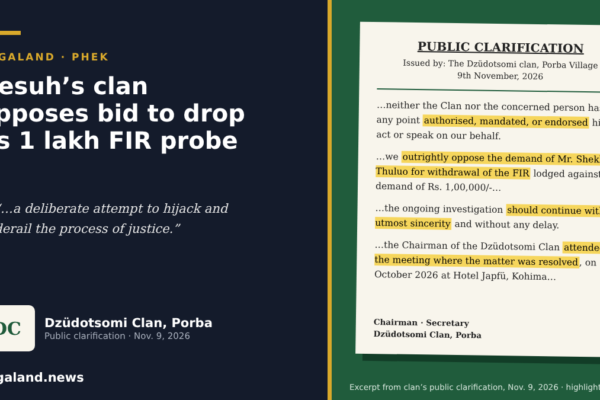
Vezhoto Hesuh’s clan opposes bid to drop Rs 1 lakh FIR
Porba's Dzüdotsomi clan says Shekho Thuluo had no mandate to speak for it and calls his demand to…

KCCI tells Kohima shops to repaint shutters by November 30
Shops must also clean up signboards and add LED lighting; British Paints offers 40 per cent off Ultra…
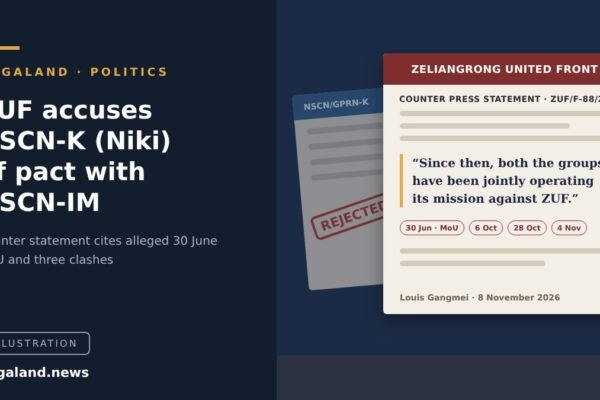
ZUF accuses NSCN-K (Niki) of June pact with NSCN-IM
In a counter statement, the Zeliangrong outfit cites an alleged 30 June MoU and three clashes, and vows…
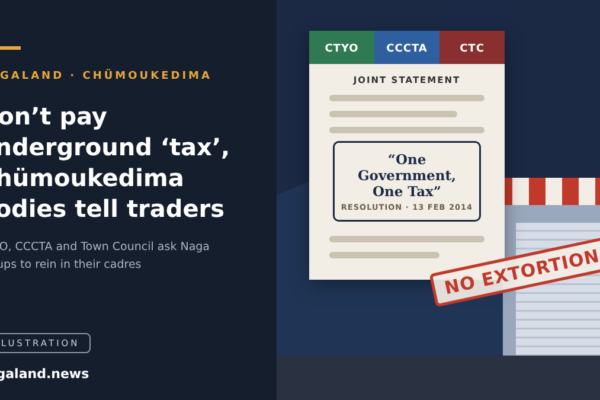
Pay no underground ‘tax’, Chümoukedima bodies tell traders
Citing reports of cadres seeking fees from construction workers, the CTYO, CCCTA and Town Council invoke the 2014…
Comments
No comments yet. Be the first to share your view.