
Nagaland Pushes Back on Vande Mataram Before Independence
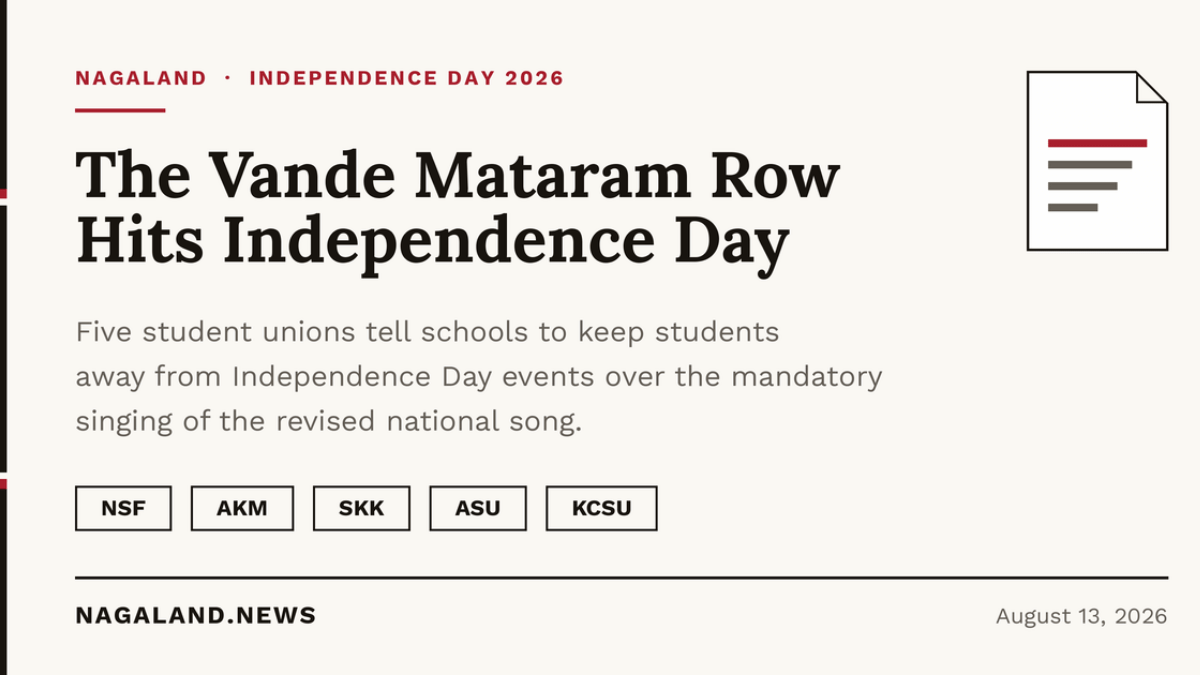
Five student bodies in Nagaland have told schools under their jurisdictions not to send students to India’s Independence Day programmes on August 15, 2026, and the state’s apex Baptist church body has now added its voice to the concern. The Naga Students Federation, the Ao Students Conference, the All Sumi Students Union, the Angami Students Union and the Kohima Chakhesang Students Union have each issued formal notifications withdrawing participation, while the Nagaland Baptist Church Council has issued a separate statement urging restraint and sensitivity on all sides. Both strands of objection trace back to a government order making the playing or singing of the revised Vande Mataram compulsory at official functions and in educational institutions.
With Independence Day only two days away, the coordinated notifications and the church council’s intervention mark one of the sharpest standoffs between Naga civil society and the union government over the national song in recent memory, and the list of institutions weighing in is still growing.
Naga Students Federation Sets the Tone
The Naga Students Federation, the apex student body for the Naga homeland, issued the first notification on August 12 from its headquarters at Naga Solidarity Park, Kohima. It directed all federating units and subordinate bodies to ensure that schools and educational institutions in their areas do not send students to Independence Day programmes until the order requiring the singing of the revised national song is withdrawn. Also Read Nagaland Police Officer Arrested After Allegedly Threatening Delhivery Executive with Pistol Over ₹600 COD Parcel in Chümoukedima
The federation was careful to draw a line around its objection. It said it has no quarrel with Independence Day celebrations or with showing respect to the National Flag, the National Anthem or any other national symbol. Its concern, the notification said, is solely with compelling students to take part in Vande Mataram, given that the song’s devotional and religious imagery does not sit well with the sincerely held beliefs of students who are not Hindu.
The notification also cited India’s status as a secular republic and the constitutional guarantee of freedom of conscience and religion, arguing that no student should be forced into a religiously sensitive expression against personal belief. It referred back to an earlier objection the federation had raised with the union government over a Ministry of Home Affairs communication dated January 28, 2026, which set out the protocol for playing and singing Vande Mataram. The federation also invoked Article 371A of the Constitution, which grants special protections to Naga customary law, religious practice and social institutions.
The notification instructed all federating units to make sure no student faces disciplinary action, discrimination, intimidation or academic consequences for declining to take part in Vande Mataram on grounds of conscience or religion. It was signed by federation president M Teisuding and general secretary Kenilo Kent.
Ao Students Conference Backs the Directive
The Ao Students Conference, headquartered in Mokokchung, followed on the same day with its own notification, referenced as Akm/Gs/Noti-04/26. Citing the federation’s directive directly, it asked all schools and educational institutions in its jurisdiction not to send students to the Independence Day celebration on August 15 until further direction is given.
The conference tied its position squarely to the concerns raised over the compulsory singing of the revised Vande Mataram and the need to protect students’ freedom of conscience and religious belief. It asked all concerned parties to strictly comply. The notification was signed by conference president Lanulemba Longchar and general secretary Aomayang Longkumer, and it enclosed a copy of the federation’s original letter.
All Sumi Students Union Reaffirms the Position
The All Sumi Students Union, based in Zunheboto, issued its notification a day later, on August 13. Referring to the federation’s earlier directive, the union reaffirmed what it called a strong and principled stand against compelling students to sing or play Vande Mataram during Independence Day programmes.
The union said it respects the National Flag, the National Anthem and other recognised national symbols, and framed its position as a call for mutual respect between national duty and religious conscience rather than a rejection of the day itself. It directed all its units and subunits to ensure that no Sumi student takes part in any Independence Day programme or celebration this year. The notification was signed by union president Hipito Achumi and general secretary P Samuel Chophy.
Angami Students Union Calls on the Naga People to Stay Away
The Angami Students Union, headquartered in Kohima, issued a notification dated August 12 under the subject line Compliance with NSF Directive on Vande Mataram and Independence Day 2026. It directed all subordinate units and affiliated bodies to ensure that no student takes part in any Independence Day programme this year, in line with the federation’s directive.
The union went a step further than the other bodies, appealing to the wider Naga populace to rise in unison and abstain from attending Independence Day events altogether. It said the freedom of conscience and religious belief of every student must be respected, and that no student should face punishment for declining to participate. The notification was signed by union president Diezevisie Nakhro and vice president Zhovito Rikha.
Kohima Chakhesang Students Union Writes Directly to the Government
The Kohima Chakhesang Students Union took a different route from the other four bodies. Rather than issuing a directive to its own subordinate units, it wrote a formal letter dated August 13 straight to the Director of the Art and Culture Department, Government of Nagaland, under the subject line Withdrawal of Participation for the Independence Day Program.
The union told the department it regretted to inform that it would not be able to take part in the upcoming Independence Day programme on August 15. Describing itself as a subordinate unit that is firmly bound to comply with the federation’s directive, the union said it was withdrawing its participation in solidarity with the Naga Students Federation and in strict adherence to its mandate. The letter closed with the union’s motto, Unity Wins the Crown, and was copied to the Art and Culture Department, the Naga Students Federation and its own office file. It was signed by union president Kuwe Mekru and general secretary Mhasekhoyi Rhakho. Also Read 150 Pizzas That Never Existed: How a Fake Bill Fooled National Media
Unlike the other four notifications, which were addressed inward to schools and constituent units, the Kohima Chakhesang letter is addressed outward to a state government department, putting the union’s withdrawal on official record with the very office that organises the Independence Day programme.
Nagaland Baptist Church Council Calls for Sensitivity, Not Compulsion
The Nagaland Baptist Church Council, the central organisation of Baptist churches and associations across the state, issued its own statement on August 13, titled Patriotism Without Compulsion, A Call for Respect and Sensitivity.
The council said it was voicing deep concern over any directive or practice that seeks to impose the singing of Vande Mataram on citizens, particularly the Christian community. It said it fully respects India’s national symbols, patriotic sentiments and constitutional values, but argued that patriotism should arise from willing participation and shared love for the nation rather than through compulsion. The statement noted that the council had already set out its position in a public statement carried by local newspapers, and said that position remains unchanged.
Unlike the five student unions, the council’s statement was not a directive to withdraw from Independence Day events. It read instead as an appeal for restraint on all sides. The council said unity must not be confused with uniformity, and that a citizen’s love for the nation cannot fairly be measured solely by willingness to take part in one prescribed form of patriotic expression. It said the state and public institutions carry a particular responsibility to exercise sensitivity when a symbol or practice carries different meanings for different communities.
The council acknowledged and appreciated the concerns raised by the Naga Students Federation on behalf of the student community, but urged that every response to the issue remain peaceful, responsible and respectful, and said legitimate disagreement must never become an excuse for hostility, intimidation, division or confrontation. It appealed to the government and its authorities, educational institutions, student organisations, churches, civil society and the wider public to exercise wisdom, restraint and constitutional sensitivity in addressing the matter.
The council framed its intervention as pastoral rather than political. It said it had no desire to politicise the matter or create confrontation, but could not remain silent when a practice is imposed in a way that may infringe on the freedom of conscience of individuals or communities. It closed by reiterating its commitment to mutual respect, freedom of conscience, justice, peace, constitutional values and the dignity of every citizen, saying these principles, rather than compulsion or forced uniformity, offer the surest foundation for a united and harmonious India. The statement was signed by general secretary Rev Dar Mar Pongener and Dr Villo Naleo, secretary for social concern.
The Vande Mataram Order and the New Law Behind It
The dispute traces back to a Ministry of Home Affairs directive issued on January 28, 2026, which laid down a protocol for observing Vande Mataram at official functions and in schools, including playing or singing all six verses, a performance lasting roughly three minutes, ahead of the National Anthem. The Naga Students Federation objected to the order within weeks of its issue and held a mass rally in Kohima on March 16, submitting a memorandum to the President through the Governor of Nagaland.
The tension sharpened this month when Parliament passed the Prevention of Insults to National Honour (Amendment) Bill, 2026, extending to Vande Mataram the same legal protection long given to the National Anthem. The Lok Sabha cleared the bill on July 30 and the Rajya Sabha a day earlier. President Droupadi Murmu gave her assent on August 11, making it law. Under the amended act, intentionally preventing the singing of the national song or disrupting an assembly engaged in singing it becomes a punishable offence. The Union Home Ministry has said Vande Mataram will be sung from the ramparts of the Red Fort for the first time this Independence Day.
It is against this backdrop, a compulsory singing protocol now paired with criminal penalties for disruption, that the five student bodies and the church council issued their statements within a span of two days.
The Constitutional Arguments
Each of the five student union notifications, directly or by reference, leans on Article 371A of the Constitution, which shields Naga customary law, religious practices and social institutions from ordinary parliamentary legislation without the consent of the Nagaland Legislative Assembly. The student bodies argue that a uniform national mandate on a song with religious imagery cuts against that protection, and against the pluralistic, Christian majority character of the Naga homeland.
The Nagaland Baptist Church Council did not invoke Article 371A. It framed its objection instead in the broader constitutional language of liberty, equality, pluralism and freedom of conscience, arguments that apply to Christian and minority communities across India rather than to the Naga homeland alone.
All six statements stress that their objection is about conscience and compulsion rather than a rejection of the nation or its symbols. Each affirms respect for the National Flag and National Anthem and frames its position as a defence of conscience, not a protest against Independence Day itself.
What It Means for August 15 in Nagaland
With five student unions now on record, covering the Naga Students Federation’s own federating units, the Ao area, the Sumi area, the Angami area and now the Chakhesang unit in Kohima, a significant share of schools across Nagaland are expected to keep students away from official Independence Day functions on August 15. The Kohima Chakhesang letter also means the state’s Art and Culture Department, which organises the official programme, now has at least one union’s withdrawal formally on file ahead of the event.
The Nagaland Baptist Church Council’s intervention adds a different kind of pressure. It does not call for a boycott, but its appeal to the government, educational institutions, student organisations, churches, civil society and the public to show restraint and sensitivity carries significant weight in a state where the great majority of the population is Baptist Christian. Whether state authorities or the Nagaland Board of School Education respond with a clarification before the day arrives remains to be seen.
Update, August 13, 2026: Chakhesang Students Union Issues Its Own Notification
A sixth body has now weighed in. The Chakhesang Students Union, headquartered in Phek and registered since 1974, issued its own notification dated August 12, referencing both the Naga Students Federation’s notification of the same date and its own earlier notification of March 13, 2026 opposing the Vande Mataram order.
This is a separate body from the Kohima Chakhesang Students Union covered above. The Chakhesang Students Union is the apex organisation for the Chakhesang tribe across Nagaland, while the Kohima Chakhesang Students Union is a district level unit under it. Between them, the two bodies have now put the Chakhesang tribe’s opposition on record twice in as many days, once to their own affiliated units and once directly to the state government.
The union said the Chakhesang community and the Naga people have no objection to Independence Day, the National Flag, the National Anthem or other national symbols, but that no student should be compelled to take part in any religiously or culturally sensitive expression against personal conscience. It directed all affiliated units and subordinate bodies to ensure schools in their jurisdiction do not send students to the Independence Day programme on August 15 wherever the compulsory singing or playing of Vande Mataram is imposed, until the Ministry of Home Affairs revokes the order. It further directed that any coercion, intimidation, discrimination or disciplinary action against students who decline to take part be reported immediately to the union’s office. The notification, referenced CSU/NOT-03/2026-2028, was signed by union president Povozo Soho and general secretary Rhilo Chiero, and said the directive stays in force until the order is revoked or withdrawn.
This is a developing story. Nagaland News will update this report as more organisations confirm their position.
Related Stories
FRGN directive: CNCCI asks Nagaland government to act
The Confederation of Nagaland Chamber of Commerce and Industry (CNCCI) has asked the Nagaland government to state publicly…
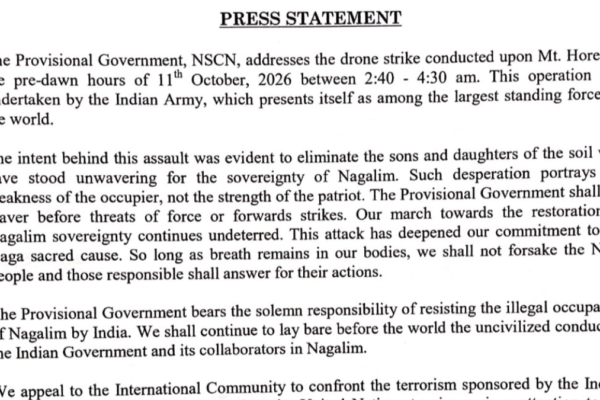
Mt Horeb drone strike: NSCN breakaway faction blames India
DIMAPUR – A breakaway Naga armed group on Saturday accused the Indian Army of carrying out a pre-dawn…
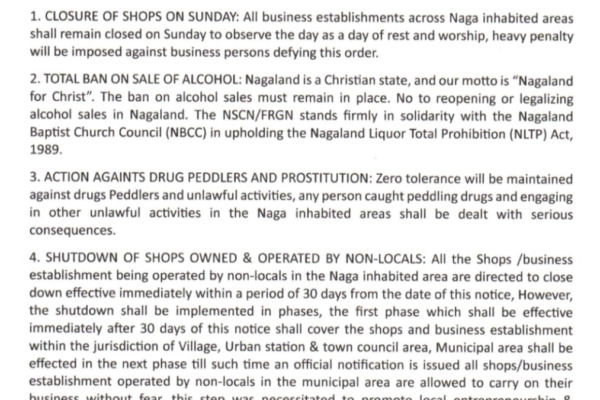
NSCN FRGN Directive: Sunday Shop Closure, Liquor Ban and 30 Day Deadline for Non Local Shops
Dimapur, October 23, 2026: In a fresh NSCN FRGN directive, the Ministry of Information and Publicity (MIP) of…
Angami Public Organisation Sets Deadlines to Restrict Employment, Services and Rental to ‘Illegal Immigrants’
The Angami Public Organisation (APO) has announced a series of resolutions concerning people it identifies as “illegal immigrants,”…