
Global Naga Forum rebuts KK Sema remarks and Alemtemshi Jamir’s history claim
The forum says state borders cannot divide Nagas, after the two retired IAS officers spoke at a CNTC meeting in Dimapur on November 11.
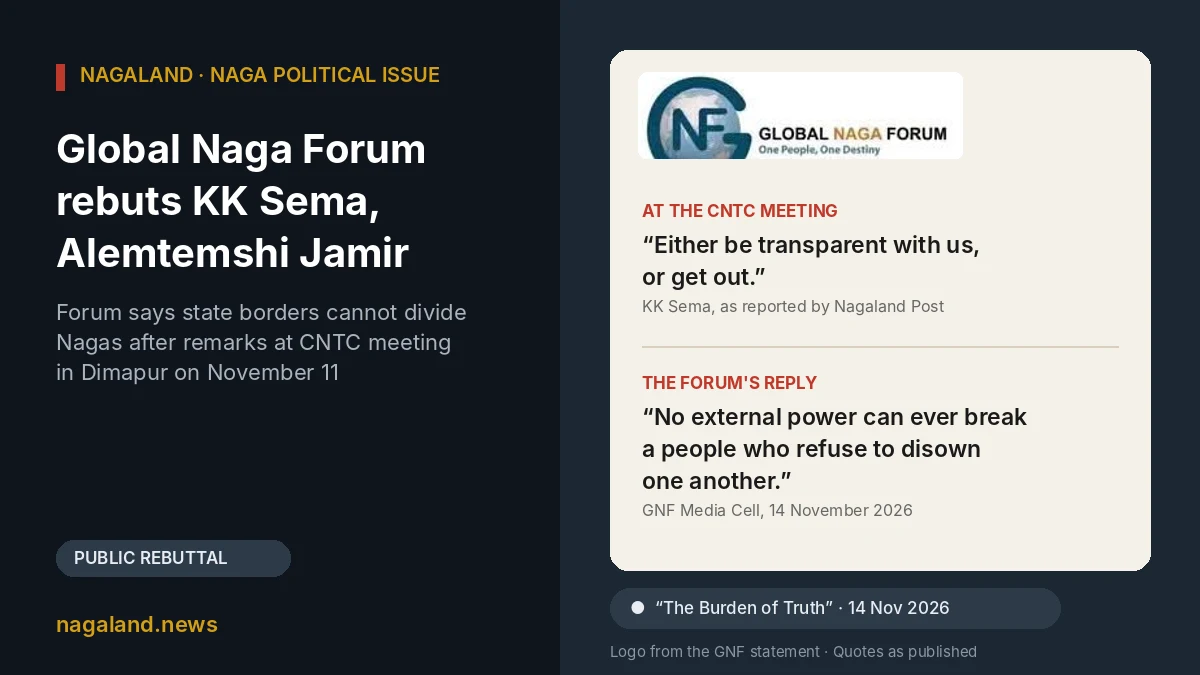
KOHIMA – The Global Naga Forum (GNF) has issued a public rebuttal to KK Sema remarks made at a Central Nagaland Tribes Council (CNTC) meeting this week, along with comments attributed to former Nagaland Chief Secretary Alemtemshi Jamir on the roots of Naga identity. In a statement dated November 14, 2026, and seen by Nagaland.News, the forum said state borders “can never divide the Naga family”.
The four-page statement, titled “The Burden of Truth: Why State Borders Can Never Divide the Naga Family”, was issued by the GNF Media Cell. The forum said it was writing “not to trade insults with individuals” but to answer what it called “divisive rhetoric”.
KK Sema remarks and Alemtemshi Jamir’s view at the CNTC meeting
The CNTC held a consultative meeting with senior citizens at its office in Dimapur on Wednesday, November 11, on the Naga political issue. Former Chief Minister Dr SC Jamir gave the main address, and retired IAS officers KK Sema and Alemtemshi Jamir were among the other speakers, Nagaland Post reported.
According to that report, Sema said the talks between the NSCN (I-M) and the Working Committee of the Naga National Political Groups (NNPGs) concern the future of the Naga people and should not belong to a few individuals or groups. He questioned the lack of transparency around the 2015 Framework Agreement, noting that the NNPGs had made their competencies public while the NSCN (I-M) had not.
Sema also raised concerns about the influence of Tangkhul leaders in the NSCN (I-M)’s decision-making, and said Nagaland’s future should not be decided by people from outside the state. “Either be transparent with us, or get out,” he was quoted as saying.
The Nagaland Post report did not carry Alemtemshi Jamir’s remarks. The GNF statement says he asserted that Nagas had “little collective identity prior to 1917” and that Naga nationalism is “a recent construct”. Nagaland.News could not independently confirm his exact words, and no video of the KK Sema speech or the wider meeting had been found online by Saturday evening.
Global Naga Forum poses three questions
The GNF described the KK Sema remarks as an “ultimatum” telling the Tangkhuls and “Southern Nagas” to “either conform to his demands for transparency or ‘GET OUT'”. It said the burden of proof lies “on those who divide” and put three questions to them.
- By what authority can an administrative state line, drawn by Parliament in 1963, be used to call fellow Nagas “unwanted strangers in their own ancestral homeland”?
- How can anyone claim exclusive ownership of Nagaland on the basis of the 1960 16-Point proposal, while setting aside its integration clause, Point 13?
- Why is transparency demanded “selectively” of one section of Nagas, while the 16-Point negotiations, which the forum says had no plebiscite or collective mandate, are treated as “beyond scrutiny”?
The history the forum cites
Responding to the 1917 argument, the forum said decentralised village self-government should not be confused with an absence of nationhood. It described the Naga nation as rooted in autonomous “Village Republics” that later adopted a federal system, and said clan and tribal lineages crossed today’s borders in Manipur, Assam, Arunachal Pradesh and Myanmar.
As evidence of earlier unity, the GNF listed Nagas working together in Upper Assam in the 1830s and 1880s, the frontier expeditions of 1911-12, more than 2,000 men recruited for the World War I Labour Corps, the Naga Club of 1918 and the 1929 memorandum to the Simon Commission. It also contrasted the 1947 Nine-Point Agreement with the 1960 16-Point proposal, and recalled that Tangkhul Naga MP Rishang Keishing had raised the integration of the Naga Hills, Tuensang and Tirap in Parliament.
Historians have long debated these milestones. The Labour Corps that served in France in 1917 is widely seen as a turning point, while the forum argues that it was not the first time Nagas from different hills came together.
Forum urges restraint and ‘dignified statesmanship’
The GNF said it supports integrity, transparency and accountability in public life, but through “institutional reform”, not “below-the-belt personal attacks or the collective scapegoating of the Tangkhul community or Southern Nagas”. It said its deepest concern was for young people, who could inherit “manufactured hatred” if elders frame Nagas across state borders as adversaries.
It called on tribal councils, senior citizens, intellectuals and public figures to rise above “parochialism and personal invective”. The statement ends: “No external power can ever break a people who refuse to disown one another.”
The exchange comes at a tense time for the Tangkhul community, after the Tangkhul Naga Long issued an ultimatum over the New Heaven ambush in Manipur’s Ukhrul district. Questions of Naga unity have also featured in recent moves among Naga political groups, including the memorandum on Naga unity signed by the GPRN/NSCN (Unification) and NNC/FGN. The Morung Express also carried the GNF statement.
Neither KK Sema nor Alemtemshi Jamir had publicly responded to the GNF statement by Saturday evening. Nagaland.News will update this story if they do.

Aloto Naga
Aloto Naga is an Indian journalist and digital media entrepreneur based in Dimapur, Nagaland. He is the founder, editor and publisher of Nagaland.News (formerly Nagaland News Today), a digital publication covering breaking news, politics, education and community developments across Nagaland and Northeast India.
More about Aloto Naga →Related Stories
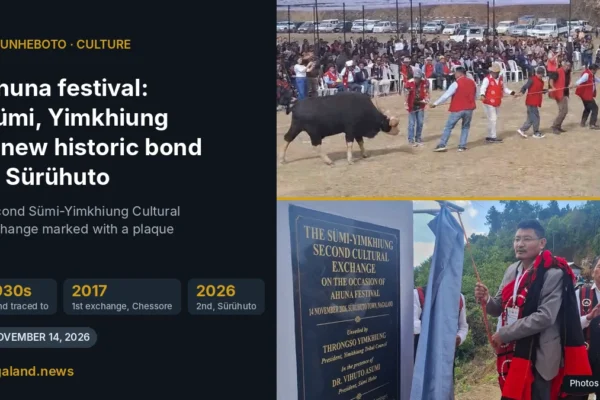
Ahuna festival: Sümi and Yimkhiung renew historic bond at Sürühuto
A plaque unveiled at Sürühuto marked the second Sümi-Yimkhiung Cultural Exchange, nine years after the first at Chessore…
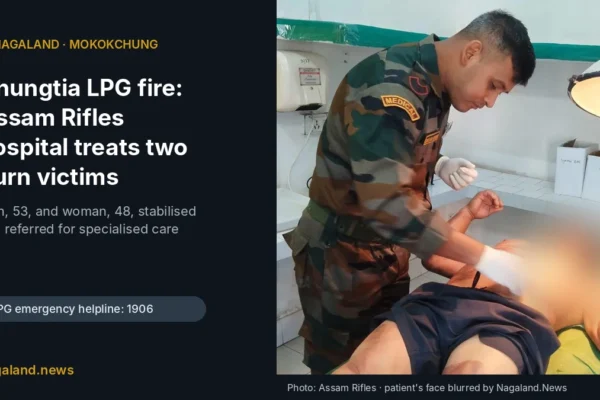
Chungtia LPG fire: Assam Rifles hospital treats two burn victims
A 53-year-old man and a 48-year-old woman were stabilised at an Assam Rifles Unit Hospital in Mokokchung district…
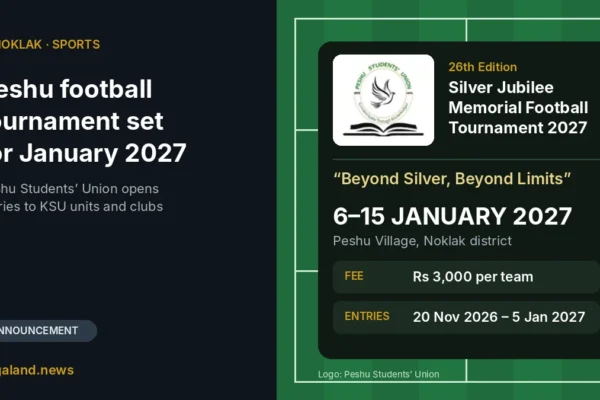
Peshu football tournament: Silver Jubilee edition set for January 2027
Peshu Students' Union will host the 26th edition at Peshu Village from January 6 to 15. Registration for…
Dimapur street vendors call for climate-resilient markets, revival of vending committee
At a Street Vendors' Day programme organised by SEWA Dimapur, women vendors spoke of high water and sanitation…
Comments
No comments yet. Be the first to share your view.