
Dimapur street vendors call for climate-resilient markets, revival of vending committee
At a Street Vendors' Day programme organised by SEWA Dimapur, women vendors spoke of high water and sanitation costs, eviction fears and safety at 1 am.
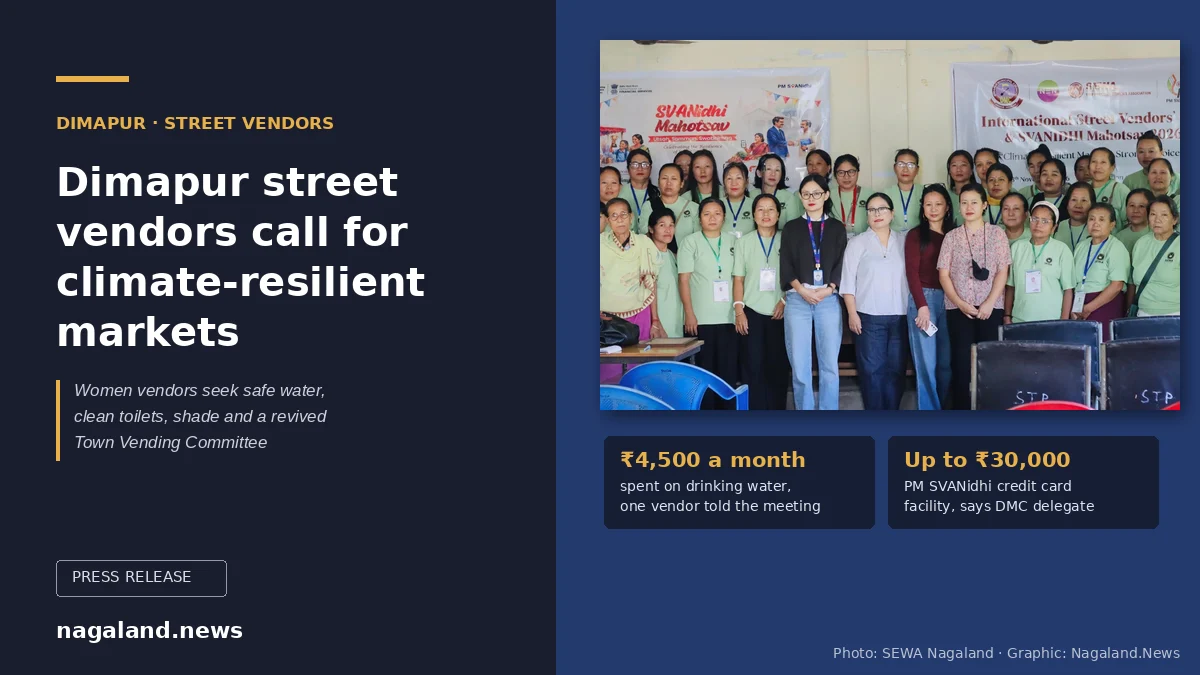
DIMAPUR – Dimapur street vendors and the Self Employed Women’s Association (SEWA) on Friday called on the authorities to revive the town’s inactive Town Vending Committee (TVC) and provide safe drinking water, shade, clean toilets and proper drainage at markets. The demands were made at a programme marking International Street Vendors’ Day and SVANidhi Mahotsav 2026.
The programme was held at DUDA Hall, Dimapur, on November 13 under the theme “Climate-Resilient Markets, Stronger Voices”, according to a press release issued to Nagaland.News by SEWA Nagaland. It was organised by SEWA, Dimapur, with North East Network (NEN) and Dimapur Municipal Council (DMC), and brought together women street vendors, government officials and other stakeholders.
What Dimapur street vendors told officials
Rita ben, one of the Dimapur street vendors who spoke, said she spends about ₹4,500 a month on drinking water and ₹3,800–₹3,900 on sanitation, the release said. She described the financial and health burden that poor facilities place on vendors, and proposed community composting to deal with market waste.
Mrs Alila from New Market recalled past eviction drives and called for a dedicated market for local Naga vendors. Mrs Bendang raised safety concerns for women who begin vending as early as 1 am. A video screened at the programme showed the everyday challenges faced by women street vendors.
The concerns come from vendors who work in some of Dimapur’s busiest markets, where Nagaland.News tracks daily vegetable and essential commodity prices.
Call to revive Dimapur’s Town Vending Committee
Temjenlemla, State Project Coordinator of SEWA Nagaland, said building climate-resilient markets needs both better infrastructure and women’s participation in decisions that affect their livelihoods. Referring to the Nagaland Street Vendors Rules, 2019, she stressed the need to revive the inactive TVC in Dimapur to strengthen dialogue between vendors and the authorities.
Town vending committees are set up under the Street Vendors (Protection of Livelihood and Regulation of Street Vending) Act, 2014. The Act requires at least 40 per cent of a committee’s members to be street vendors, and one-third of those to be women, giving Dimapur street vendors a formal say in surveys, vending certificates and vending zones.
Concluding the programme, SEWA Dimapur urged the authorities to reactivate the TVC “with meaningful representation of women street vendors” and to take “concrete, time-bound action” on safe drinking water, shaded spaces, clean toilets, proper drainage and effective waste management.
PM SVANidhi loans and plans for cleaner markets
Mrs Naro, a delegate from DMC, told Dimapur street vendors about the benefits of PM SVANidhi and a credit card facility of up to ₹30,000. She urged vendors to keep markets clean, saying it was everyone’s responsibility.
Three street vendors were recognised for their performance under the scheme, and the State Bank of India’s Dimapur Evening Branch was acknowledged for facilitating the highest number of loans. Mrs Tsipila, a vendor, said the scheme had helped her expand her business and appealed for access to MUDRA loans.
PM SVANidhi, launched in 2020, gives street vendors collateral-free working capital loans. The Union Cabinet restructured it in August 2025, raising the first two loan tranches to ₹15,000 and ₹25,000, extending lending to March 31, 2030, and adding a UPI-linked RuPay credit card for vendors who repay their second loan, The Tribune reported.
Ms Kevilenuo Solo, Secretary of Development Authority Nagaland (DAN), outlined plans under the Swachhata Committee for a pedestrian plaza, water-vending machines at nominal charges and improved public toilets, with proposed collaboration with SEWA Dimapur. Referring to the Solid Waste Management Rules, 2026, she stressed waste segregation and collective responsibility for cleaner markets.
The Centre notified those rules in January 2026, and they took effect on April 1, requiring waste to be separated at source into wet, dry, sanitary and special-care streams, Deccan Chronicle reported. The programme coincided with the state-wide mass social work on November 13.
Representatives of DMC and DAN also discussed infrastructure improvements, coordination and concerns over vending-space charges, the release said.

Aloto Naga
Aloto Naga is an Indian journalist and digital media entrepreneur based in Dimapur, Nagaland. He is the founder, editor and publisher of Nagaland.News (formerly Nagaland News Today), a digital publication covering breaking news, politics, education and community developments across Nagaland and Northeast India.
More about Aloto Naga →Related Stories

Help identify elderly man found in Moilan village, Wokha
Villagers say the man is not from the area and could not tell them his name; he is…
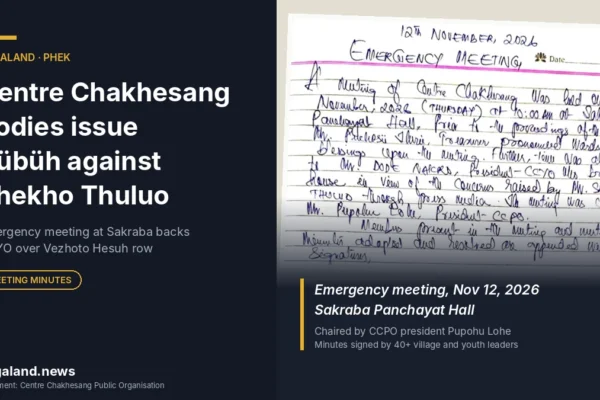
Centre Chakhesang bodies issue Kübüh against Shekho Thuluo
An emergency meeting at Sakraba backed the CCYO after Thuluo used a press conference to question the settlement…
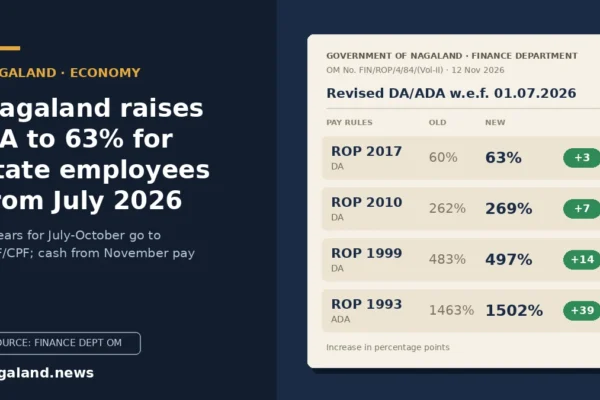
Nagaland DA hike: state employees to get 63% from July 2026
Finance Department order raises DA and ADA across four pay rules; arrears for July to October go to…

NSCN/PRN condemns Khuzama and Chümoukedima convoy blasts
NSCN/PRN says violence “cannot be justified” whoever is behind it, and offers to help security agencies probe the…
Comments
No comments yet. Be the first to share your view.