
Nagaland BMCs trained on amended Biological Diversity Act
Nagaland State Biodiversity Board's three-day programme flags gaps in BMCs and PBRs, with field visits to Khonoma and Sendenyu villages.
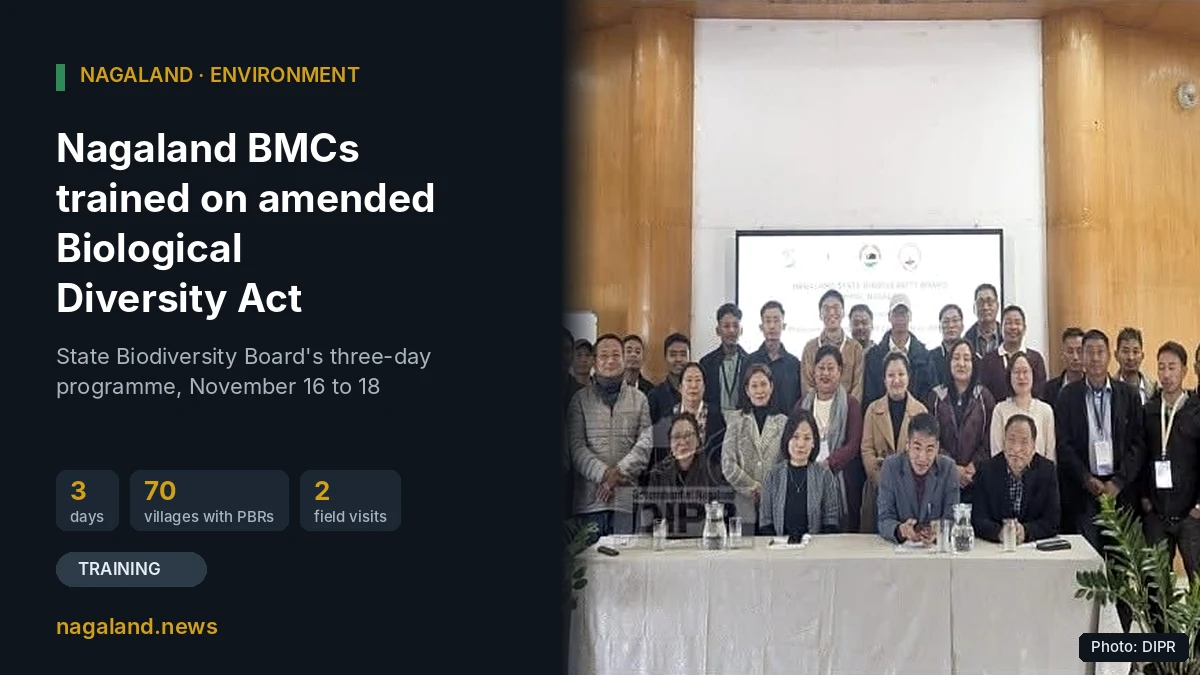
NAGALAND – Members of village-level Biodiversity Management Committees (BMCs) began a three-day training on the amended Biological Diversity Act and Rules on Monday, with officials warning that poor documentation leaves Nagaland’s plants, animals and traditional knowledge open to misuse. The Nagaland State Biodiversity Board (NSBB) is running the programme from November 16 to 18, according to a release from the Department of Information and Public Relations (DIPR) seen by Nagaland.News.
The training is meant to help BMC members understand the changes to the law, their own duties under it and why conservation matters. It is supported by the FTBC scheme of the Union Ministry of Environment, Forest and Climate Change, the release said.
What the Biological Diversity Act asks of BMCs
The Biological Diversity Act, 2002 governs who can collect and use India’s biological resources and the traditional knowledge linked to them, and how the benefits are shared with local communities. It sets up three tiers: the National Biodiversity Authority, State Biodiversity Boards and, at the local level, BMCs, which every local body is required to form under Section 41 of the Act, as the NSBB notes on its website.
Parliament amended the law in 2023, with the Rajya Sabha clearing the Bill on August 1 that year, All India Radio reported. The amendment, in force since April 1, 2024, replaced jail terms for most violations with fines, eased rules for practitioners of Indian systems of medicine and gave BMCs the task of issuing certificates of origin for cultivated medicinal plants. New Biological Diversity Rules followed in 2024.
BMCs also keep People’s Biodiversity Registers (PBRs), which record a village’s local plants, animals and crop varieties and the knowledge communities hold about them. These registers serve as evidence when outsiders seek to use those resources commercially.
Nagaland State Biodiversity Board flags gaps in BMCs and PBRs
Speaking as special guest, Supongnukshi Ao, IFS, Additional Principal Chief Conservator of Forests (APCCF) (Territorial) in the Department of Environment, Forests and Climate Change (DoEFCC), said the Nagaland State Biodiversity Board faced challenges in implementing the Biological Diversity Act. He named the constitution and strengthening of BMCs, capacity building, awareness and the preparation of PBRs as the main problem areas.
Ao credited the Forest and Biodiversity Management Project, known as the KfW project, with supporting PBR documentation in 70 villages across the state. Systematic recording of biological resources and associated traditional knowledge, he said, is essential to protect them from misappropriation. He urged BMC members to act as ambassadors of conservation in their own and neighbouring villages.
Delivering the keynote address, Conservator of Forests, DoEFCC, Lhinghoikim Touthang, IFS, described BMCs as key village institutions for conserving and sustainably managing biodiversity. She said committees should exercise their responsibilities over local resources and traditional knowledge and look for ways to earn income from their sustainable use. A sound grasp of the Biological Diversity Act, she added, is essential if BMCs are to protect their community’s biological wealth.
Biopiracy concerns and untapped insect resources
Kruolalie Tsürho, Team Leader of the Nagaland Bioresource Mission, pointed to the state’s wide range of medicinal plants and raised concern over biopiracy and the unauthorised use of biological resources. He also called for further study and documentation of insect resources, which he said hold untapped potential.
Tsürho said stronger BMCs were needed to ensure the state’s biological resources are conserved and used sustainably. The inaugural session was chaired by NSBB Consultant Khotuo Belho. Range Forest Officer, NSBB, Savinuo Kikhi gave the welcome address, and NSBB Technical Executive Keneizenuo Seletsu proposed the vote of thanks.
Field visits to Khonoma and Sendenyu
Technical sessions on the first day cover the key provisions of the amended Act and Rules and the roles of BMCs. Participants will then visit Khonoma village on the second day and Sendenyu village on the third, to see how community-based conservation and BMCs work on the ground.
Both villages are known for community-led conservation. Khonoma, west of Kohima, set aside forest for the Khonoma Nature Conservation and Tragopan Sanctuary in 1998 after banning hunting. Sendenyu, a Rengma Naga village in Tseminyu district, declared a community wildlife reserve in 2001, EastMojo has reported. The release did not name the venue of the inaugural programme or the number of BMC members taking part.

Aloto Naga
Aloto Naga is an Indian journalist and digital media entrepreneur based in Dimapur, Nagaland. He is the founder, editor and publisher of Nagaland.News (formerly Nagaland News Today), a digital publication covering breaking news, politics, education and community developments across Nagaland and Northeast India.
More about Aloto Naga →Related Stories

Nagaland notifies agriculture marketing rules under 2020 Act
The Governor has notified the Nagaland Agriculture Produce & Livestock Marketing (General) Rules, 2024, to give effect to…
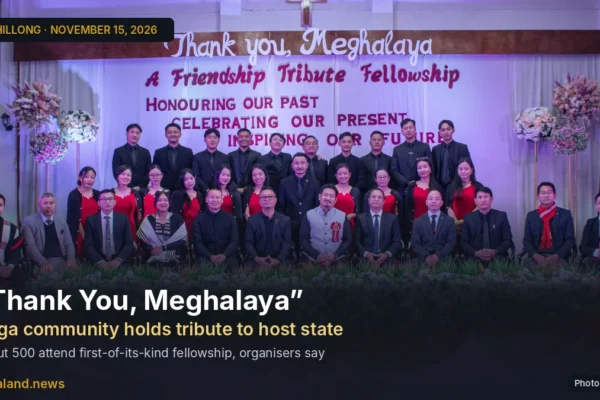
“Thank You, Meghalaya”: Nagas in Shillong hold first-of-its-kind tribute
About 500 people joined the Naga Elders’ Forum Shillong and the NCFS in thanking Meghalaya at Nongrim Hills,…

National Press Day 2026: Kohima speakers urge facts over populism
At a DIPR programme in Kohima, Advisor Daochier I. Imchen and senior journalist H. Chishi urged the press…
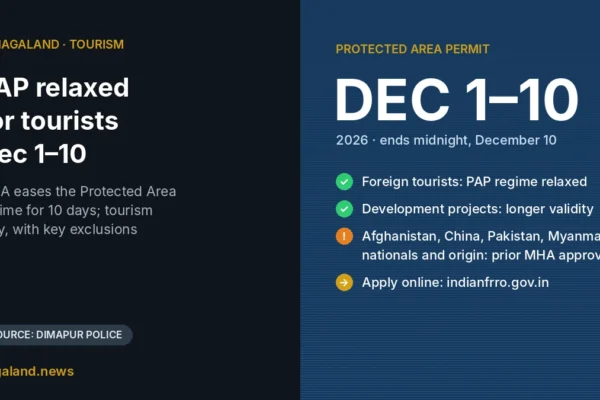
Nagaland PAP relaxation for foreign tourists set for December 1 to 10
Dimapur Police say the Centre's eased permit regime is for tourism only. Nationals of Afghanistan, China, Pakistan and…
Comments
No comments yet. Be the first to share your view.