
Tangkhul body in Delhi challenges Seilen Haokip to prove history claims
Tangkhul Naga Longnao Delhi says the KNO spokesperson's reported claim that Tangkhul identity began with missionary William Pettigrew is untenable.
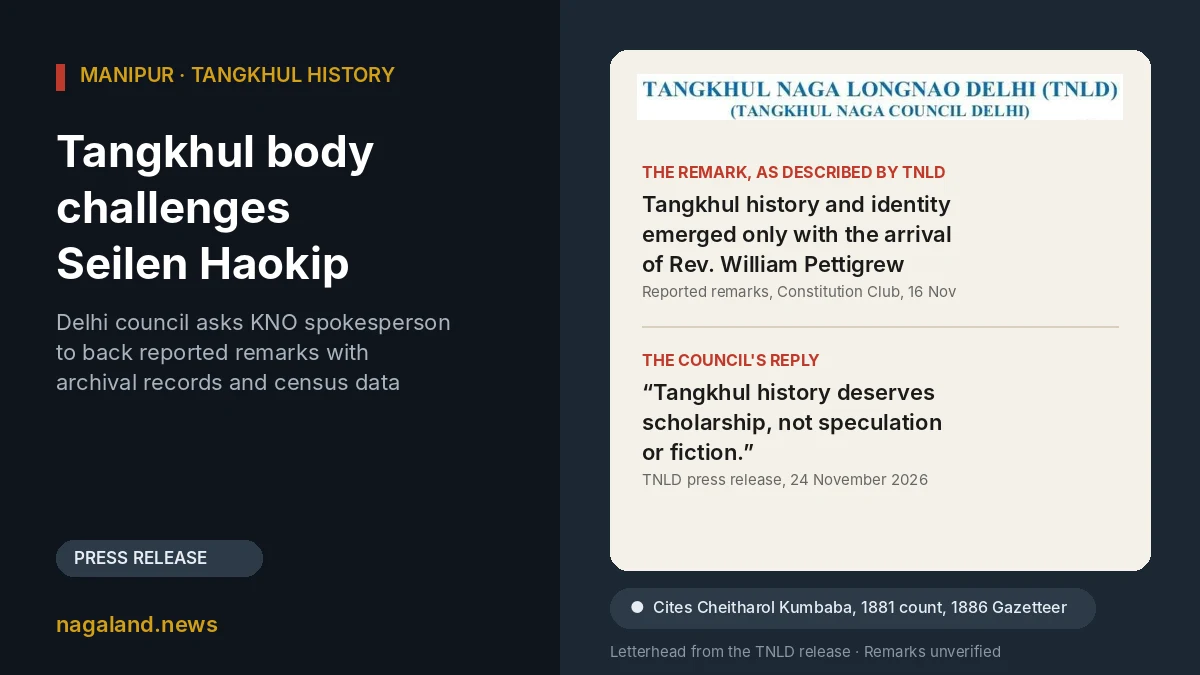
NEW DELHI – The Tangkhul Naga Longnao Delhi (TNLD) has challenged Dr Seilen Haokip, spokesperson of the Kuki National Organisation (KNO), to back his reported remarks on Tangkhul history with “verifiable archival records, primary sources, census data, and credible historical scholarship”. The Delhi-based Tangkhul council made the demand in a press release dated 24 November 2026, seen by Nagaland.News.
According to the TNLD, Seilen Haokip suggested at the Constitution Club, New Delhi, on 16 November that Tangkhul history and identity emerged only with the arrival of Christian missionary Rev. William Pettigrew, and that Kukis historically outnumbered Tangkhuls. The council called these assertions “historically untenable, intellectually unsubstantiated, and irresponsibly provocative”.
What Seilen Haokip is reported to have said
Nagaland.News has not seen a recording or transcript of the remarks on Tangkhul history, and they are described here only as reported by the TNLD and others. The 16 November press conference was convened by the Kuki-Zo Women’s Forum, Delhi and NCR, under the theme “Honour the War. Recognise the People. Deliver the Solution”, Deccan Chronicle reported.
That report quoted Haokip as saying a separate administration for the Kuki-Zo people “did not amount to secession” and asking, “How can we be non-indigenous?” It did not mention any remarks about the Tangkhuls. An opinion piece in India Today NE on 23 November also said Haokip had “reportedly” made the Pettigrew and population claims, and asked him to publish his evidence.
Neither Haokip nor the KNO had publicly responded to the TNLD statement at the time of writing. Nagaland.News will update this story if they do.
Tangkhul history before Pettigrew, according to the TNLD
The council said Tangkhul identity predates colonial and missionary activity and is rooted in “ancestral occupation, village institutions, customary laws, clan lineages, oral traditions, indigenous knowledge, and enduring cultural continuity”. It said Pettigrew’s contributions to Tangkhul education, literature and Christianity “remain significant”, but that missionary history “cannot be equated with the origins of an entire people”.
As evidence, the TNLD cited the Cheitharol Kumbaba, the royal chronicle of Manipur, which it said records military encounters involving Tangkhul settlements, including Chingshong during King Thawanthaba’s reign (c. 1195-1231 CE), and the Tangkhuls of Monthou in 1404 CE. It said these records place the Tangkhuls in the region centuries before Pettigrew arrived in Manipur in 1894.
The council also pointed to Nathan Brown’s 1837 publication, “Comparison of Indo-Chinese Languages”, which it said identifies Northern, Central and Southern Tangkhul speech varieties. It added that the later emergence of a common language or a consolidated identity “cannot be confused with the historical origins of communities that already existed”.
Population claim and colonial records
On the population claim, the TNLD cited E. W. Dun’s Gazetteer of Manipur (1886), which it said draws on the 1881 enumeration and records 32,952 people under “Tankul and Lahupa”, historical names associated with the Tangkhuls. It said the 1882 Report on the Administration of the Province of Assam identifies the Lahupa as the “Tangkhul tribe of Nagas”.
The council also referred to accounts that distinguish between Old and New Kuki migration streams. It cited Sir James Johnstone’s My Experiences in Manipur and the Naga Hills (1896), which it said documents Kuki immigration from the 1830s and 1840s, and G. A. Grierson’s The Languages of India (1903) on the use of the term New Kukis for later migrants. These are the council’s readings of the sources, and the history of settlement in Manipur remains contested between communities.
The TNLD further argued that population figures from any one period “cannot independently establish territorial ownership or invalidate another community’s customary land rights”. It said Haokip’s own doctoral thesis, Identity, Conflict and Nationalism: The Naga and Kuki Peoples of Northeast India and Northwest Burma (Myanmar), acknowledges the development of a shared Tangkhul language across villages with distinct dialects.
TNLD asks Seilen Haokip to “cease spreading historical falsehoods”
The council accused Seilen Haokip of making “fabricated and misleading claims” and advised him to “cease spreading historical falsehoods”. It said it was responding because such claims could cause widespread public misconception “during the prevailing volatile situation in Manipur”, where Tangkhul Naga bodies, including the Tangkhul Naga Long, which issued an ultimatum after recent killings in Ukhrul district.
“Tangkhul history deserves scholarship, not speculation or fiction; historical evidence, not political invention; and respect, not erasure,” the statement said. It was signed by TNLD president Prof. (Dr) Yaruingam Awungshi and general secretary Dr Pamreihor Khashimwo. Ukhrul Times also reported the statement.
Haokip is also described by Deccan Chronicle as chairman of the Kuki National Army. The KNO is one of the Kuki-Zo umbrella groups under the Suspension of Operations (SoO) pact with the Centre and the Manipur government, which expired on 4 September and has not been formally renewed.

Aloto Naga
Aloto Naga is an Indian journalist and digital media entrepreneur based in Dimapur, Nagaland. He is the founder, editor and publisher of Nagaland.News (formerly Nagaland News Today), a digital publication covering breaking news, politics, education and community developments across Nagaland and Northeast India.
More about Aloto Naga →Related Stories
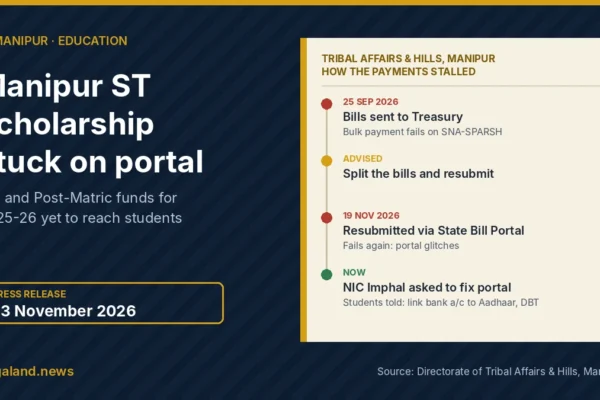
Manipur ST scholarship stuck as payment portal fails twice
Bills sent on September 25 and again on November 19 failed on SNA-SPARSH and State Bill Portal glitches,…
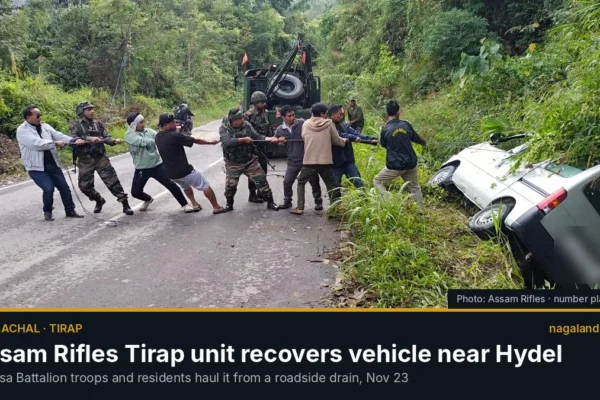
Assam Rifles Tirap unit recovers vehicle off road near Hydel
Khonsa Battalion soldiers and local residents pulled a vehicle out of a roadside drain in Arunachal Pradesh on…

NSCN (IM) confirms school for Naga children in Myanmar
A senior NSCN (IM) functionary tells Nagaland.News the group's Mount Veda Peace Mission runs the school seen in…
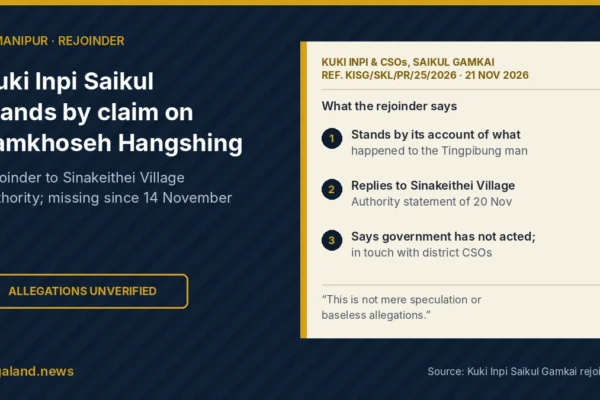
Kuki Inpi Saikul stands by claim on missing Lamkhoseh Hangshing in rejoinder to Sinakeithei
Saikul bodies repeat their unverified account of what happened to the Tingpibung man, accuse Sinakeithei village and say…
Comments
No comments yet. Be the first to share your view.