
Nagaland implements Agarwood Policy 2026 to boost farmers’ livelihoods
The policy targets about 500 hectares of new agarwood plantations a year for a decade, plus grower registration, processing units and training.
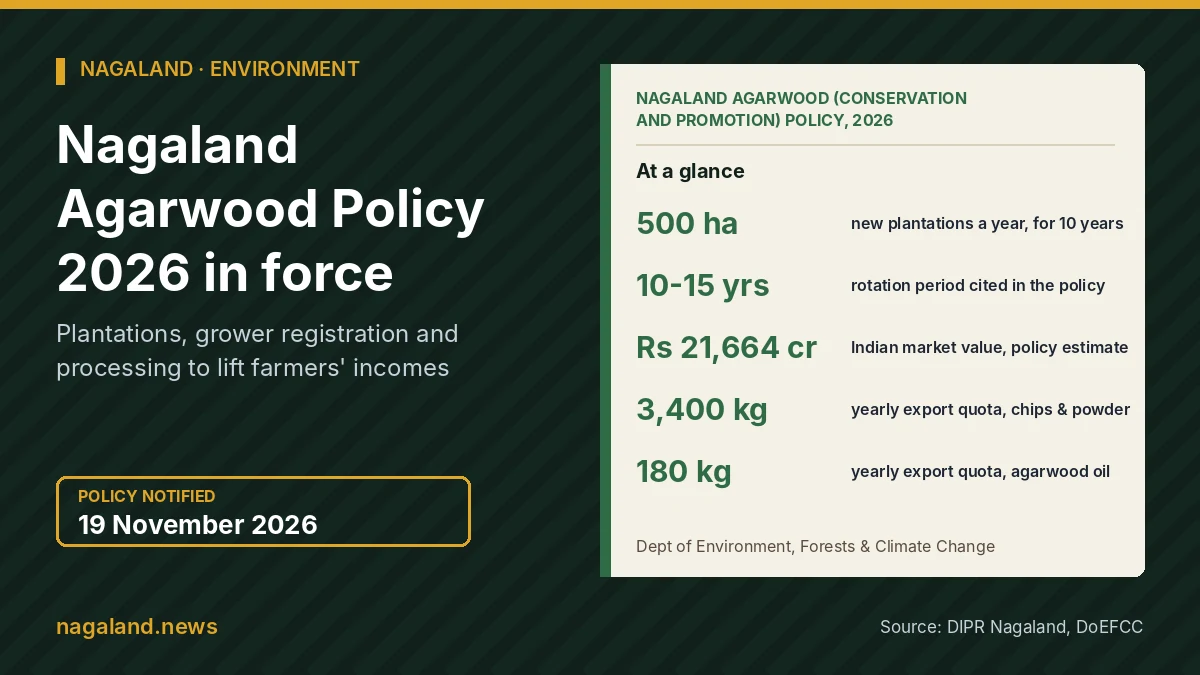
KOHIMA – The Nagaland Agarwood Policy has come into force, with the state government setting out plans to plant around 500 hectares of agarwood every year for the next decade and to register growers’ trees for legal trade. The Department of Environment, Forests and Climate Change (EF&CC) on Thursday, November 19, notified the implementation of the Nagaland Agarwood (Conservation and Promotion) Policy, 2026, according to the state’s Directorate of Information and Public Relations (DIPR).
The department presents agarwood as an alternative livelihood for farmers who now depend on jhum (shifting) cultivation. The policy was drafted after consultations with the Rain Forest Research Institute (RFRI), Jorhat, in March and approved by the State Cabinet on May 6, department officials have said.
What the Nagaland Agarwood Policy provides
The policy lists eight broad objectives, led by conserving and expanding agarwood resources through agroforestry models that can raise farm incomes, The Morung Express reported from the DIPR release. Its main commitments are:
- Plantations: about 500 hectares of new agarwood plantations a year over 10 years, on degraded forest land and on community and private land.
- Planting material: regional nurseries for quality seedlings, with saplings sourced from certified agencies in the early years.
- Registration and rules: new rules and guidelines for registering trees and plantations, and for harvesting, processing and transporting agarwood and its products.
- Processing: technical and financial support for units making agarwood chips and oil, plus market linkages.
- Training: courses for farmers, extension workers and forest staff on plantation management, artificial inoculation and post-harvest processing.
- Royalty: an “appropriate” royalty schedule meant to give better returns to local growers and traders while earning revenue for the state.
The policy also commits the department to review its felling and transit rules so that they match those of neighbouring states and national and international regulations. Artificial inoculation, which induces the resin that gives agarwood its value, will be facilitated where natural infection is low.
The published summaries do not give any subsidy amounts, a budget, royalty rates or a date for the new registration rules. The department says it will prepare the schemes needed to meet the policy’s objectives in coordination with other agencies.
Where agarwood grows in Nagaland
According to the policy, natural agarwood occurs in the state’s foothills and warmer areas, including Tzurang Valley, Japfukong, Tuli, Sitap, Tamlu, Oting, Upper Tiru, Lower Tiru, Tizit, Athibung and Beisumpui. It says these areas produce superior-quality agarwood through natural infection, but that unscientific extraction and habitat loss linked to jhum have reduced the natural stands.
Forest resources will be mapped with the RFRI, the Botanical Survey of India (BSI) and Nagaland University, and the findings will be published. At a workshop in Dimapur on June 16, Forest Minister CL John cited a 2024 BSI report that put the number of agarwood trees in Nagaland older than two years at about 22.8 lakh.
Why the state is betting on agarwood cultivation
The policy states that more than 75 per cent of Nagaland’s farmers practise jhum, which meets about 60 per cent of the state’s food needs. It also cites the India State of Forest Report 2023, which recorded a loss of more than 264 sq km of forest cover in Nagaland over four years, among the five largest declines in the country.
Agarwood, an evergreen tree with a harvest cycle of 10 to 15 years, is described in the policy as suited to jhum land and compatible with organic farming. The document puts the value of India’s agarwood market at more than Rs 21,664 crore (about USD 2.4 billion).
Agarwood is the dark, fragrant resin-filled heartwood that forms in Aquilaria trees, mainly Aquilaria malaccensis in Northeast India, after infection or injury. It is used in perfume (oud), incense and traditional medicine. Because of over-harvesting, Aquilaria species are listed in Appendix II of the Convention on International Trade in Endangered Species of Wild Fauna and Flora (CITES), which allows export only under permits and national quotas.
Export quota and catching up with Assam and Tripura
The state’s share of those quotas is small. Under the Directorate General of Foreign Trade’s export policy, Nagaland may export 3,400 kg of agarwood chips and powder and 180 kg of oil a year, about 2.25 per cent and 2.55 per cent of India’s national quota, the department said in March. Minister John has asked the Centre to raise the limits.
Y. Kikheto Sema, the department’s senior-most officer, has said Assam and Tripura dominate production and exports because they already have policies in place, and that traders from neighbouring states buy Nagaland’s agarwood without any local processing. The department signed a memorandum of understanding with the RFRI in Dimapur on August 1, Nagaland Post reported, covering sapling quality, farmer training, harvesting protocols and the institute’s inoculation technology.
The policy follows other recent moves by the same department, including training for village biodiversity management committees. How quickly growers benefit from the Nagaland Agarwood Policy will depend on the registration and transit rules, which are still to be framed.

Aloto Naga
Aloto Naga is an Indian journalist and digital media entrepreneur based in Dimapur, Nagaland. He is the founder, editor and publisher of Nagaland.News (formerly Nagaland News Today), a digital publication covering breaking news, politics, education and community developments across Nagaland and Northeast India.
More about Aloto Naga →Related Stories

Nagaland astro-tourism push: Starscapes MoU brings stargazing to Hornbill 2026
The state's tourism minister says the deal with Starscapes will bring guided stargazing to Kisama in December, train…

Col. (Retd) Longri Imsong laid to rest at Hebron with NSCN honours
Naga Country News reported a gun salute and flag handover at the NSCN's council headquarters. The date and…
Nagaland Vitamin A campaign launched to protect every child under five
NHM's awareness drive aims to get all nine Vitamin A doses to every child under five, as NFHS-6…

Mon financial literacy camp trains 72 SHG members, CLF leaders
SHG members and Cluster Level Federation office bearers learnt about bank products, digital payments and internet banking at…
Comments
No comments yet. Be the first to share your view.