
Mon Excise destroys seized liquor worth Rs 28.38 lakh
Official calls it one of Mon's largest liquor destructions by value and flags a lack of labs to test liquor after Mangkolemba and Tuensang deaths.
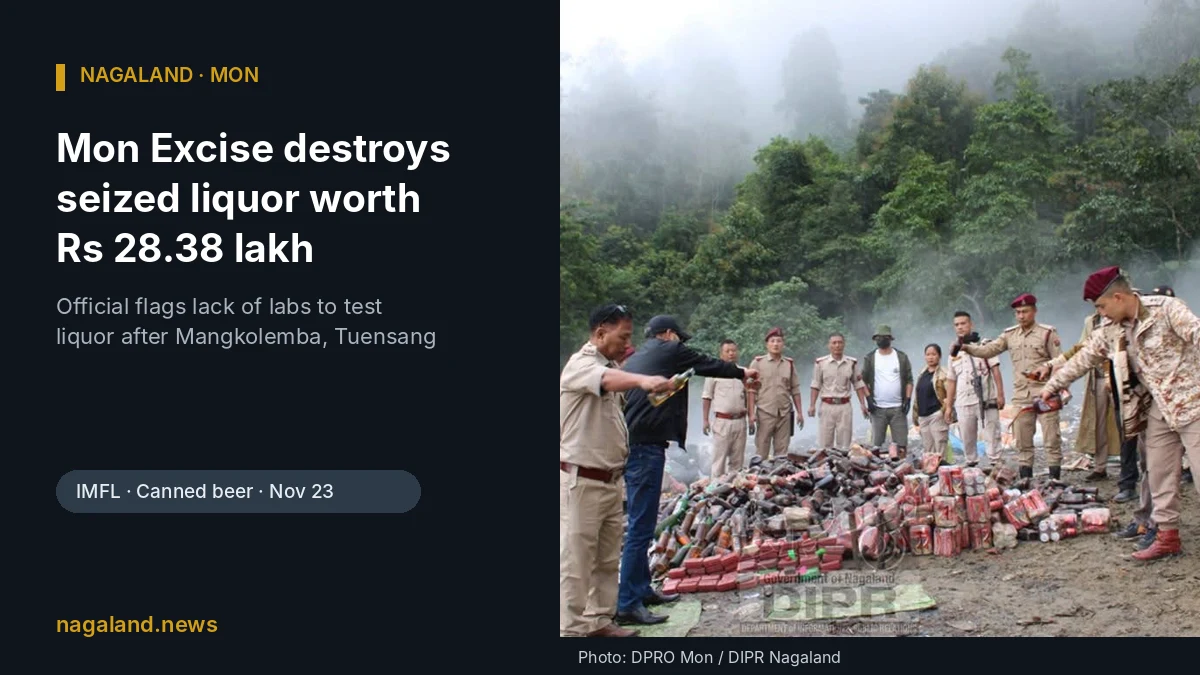
MON – Seized liquor with an estimated market value of Rs 28,38,100 was destroyed at the Dumping Yard in Mon on Monday, November 23, 2026, in what officials called one of the largest destructions in the district by value. The Mon liquor destruction was carried out by the office of the Superintendent of Excise & Prohibition, Mon.
Indian Made Foreign Liquor (IMFL), canned beer and other related items were among the goods destroyed, according to a report published by the Directorate of Information and Public Relations (DIPR). The figure works out to a little over Rs 28.38 lakh.
Excise official cites manpower and lab gaps at Mon liquor destruction
Katoho Sumi, Joint Commissioner of Excise & Prohibition (HQ) and Chairman of the Destruction Committee, used the occasion to speak plainly about the limits his department works under. He pointed to a shortage of manpower and inadequate infrastructure.
He singled out the lack of proper laboratory facilities to test whether liquor is genuine, citing recent incidents at Mangkolemba in Mokokchung district and in Tuensang. Without such testing, he said, enforcement becomes harder.
Both places were hit by suspected spurious liquor deaths in recent months. Nine deaths were reported in Tuensang town and Chendang Saddle in September. Days later, Mokokchung Police reported deaths in Mangkolemba Sub-Division linked to suspected adulterated rum, The Morung Express reported, and three more deaths followed in Longphayimsen village in the same sub-division in mid-October. The special police investigations into both cases had not been closed as of mid-October.
Prohibition began with church and mothers’ bodies
Sumi reminded the gathering that the prohibition movement in Nagaland was started by the Nagaland Baptist Church Council (NBCC) and the Nagaland Mothers’ Association (NMA). The Nagaland Liquor Total Prohibition (NLTP) Act followed their demand, and he said it was passed in 1990.
He acknowledged that the Excise department had faced numerous allegations over the years. Even so, he urged staff to stay committed, saying they were not lagging behind in their duties and were working for the betterment of Naga society.
Destroying illegal liquor, Sumi said, helps save lives and protects society from its harmful effects. As the nodal department for enforcing prohibition, the department needs the public’s help, he added.
Appeal to public, NMA and NBCC
Sumi appealed to the public and to organisations to report activities involving anti-social elements and to hand over seized or related articles to the Excise department. He also asked organisations working under the umbrella of the NMA and NBCC to cooperate with and support the department in enforcing the prohibition law.
The programme was chaired by Sangkum Ramchi B, Assistant Inspector of Excise, Mon. A. Bauloi Phom, Superintendent of Excise & Prohibition, Mon, presented the introductory report. DIPR said the exercise was part of the department’s efforts to enforce prohibition and curb the illegal sale and distribution of liquor in the district.
Why enforcement of the NLTP Act is under scrutiny
The Mon liquor destruction comes as the decades-old prohibition law faces fresh debate. Political voices have questioned how it is enforced, including the NPP call for strict NLTP Act enforcement, and the recent deaths have revived arguments both for tighter checks and for regulated sale.
Neighbouring Manipur has faced a similar crisis this month, with Manipur Police issuing an advisory after liquor deaths in Chandel.

Aloto Naga
Aloto Naga is an Indian journalist and digital media entrepreneur based in Dimapur, Nagaland. He is the founder, editor and publisher of Nagaland.News (formerly Nagaland News Today), a digital publication covering breaking news, politics, education and community developments across Nagaland and Northeast India.
More about Aloto Naga →Related Stories
Sümi Youth Organization demands Mojeh Maring apology over KK Sema post
SYO says copying the post from a WhatsApp group does not absolve him, and calls remarks attributed to…

NLTV reporter says DIPR official stopped him from asking about CM Rio’s ‘migrant’ remark
A viral video shows Advisor Hekani Jakhalu walking away as the reporter presses her on the Garo ‘migrant’…
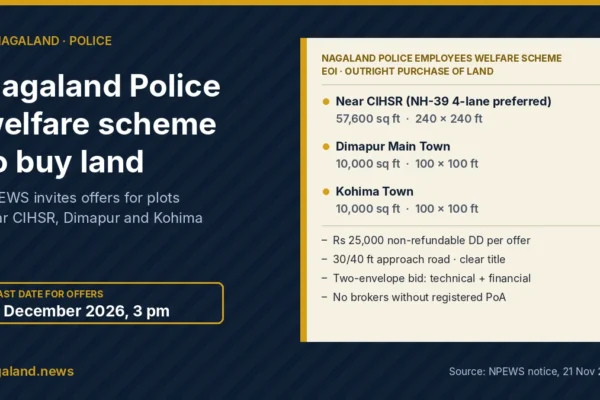
Nagaland Police land purchase: NPEWS seeks plots near CIHSR, Dimapur, Kohima
NPEWS wants plots near CIHSR, in Dimapur and in Kohima for police quarters. Each offer needs a Rs…
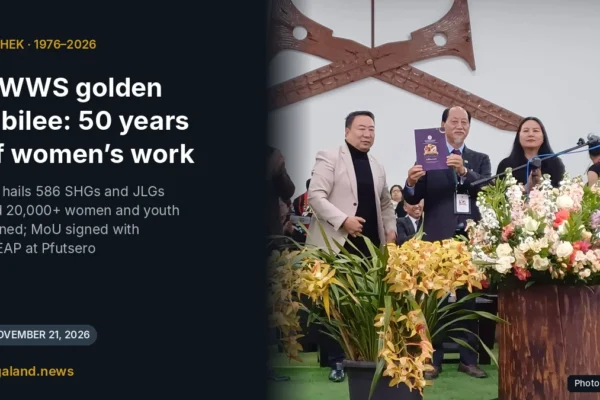
CWWS golden jubilee: Rio says women are leaders, not just beneficiaries
The Chakhesang Women Welfare Society marked 50 years at Pfutsero, with Rio crediting it for 586 SHGs and…
Comments
No comments yet. Be the first to share your view.