
Blame the leaders, not the tribe: A reply to KK Sema
A NEHU philosophy professor argues that KK Sema's remarks on the Tangkhul Nagas and 'South Nagas' blame entire communities for the mistakes of a few leaders, and applies the same test to Sema political history.
Opinion | By Dr. Xavier P. Mao
SHILLONG – No Naga tribe owns the Naga political movement, and no Naga tribe should be made to answer, as a whole, for what a handful of its leaders did. That principle is worth restating now, because the recent public remarks of Khekiye K. Sema, better known as KK Sema, come dangerously close to forgetting it.
The Naga struggle is a shared history built by many tribes, communities and leaders. It holds sacrifice and achievement, but also quarrels, errors and, at moments, real betrayal. Judging that history fairly means placing responsibility where it belongs.
What KK Sema said about the Tangkhul Nagas
On 12 November 2026, the Central Nagaland Tribes Council held a Senior Consultative Meeting in Dimapur on the Naga political issue. Speaking there, KK Sema reportedly addressed the Tangkhul Nagas and told them to “get out of Nagaland”.
This was not an isolated remark. On a number of occasions he has publicly faulted Tangkhul Naga leaders for what he regards as their political errors. He has also spoken again and again about “the South Nagas” without ever making clear which people he means or what conduct he objects to.
That raises a simple question. Can it be justified, on intellectual or historical grounds, to hold a whole tribe, or a whole region, accountable for the choices and actions of particular individuals?
Mistakes belong to leaders, not to whole tribes
Nobody can deny that leaders of different Naga tribes have made political mistakes at different points in the movement. Some of those mistakes were grave; others mattered far less. The contribution each tribe has made to the struggle has also differed widely, for better and for worse.
But historical criticism has to be aimed at the people, organisations and decisions that were actually responsible. It cannot be turned into a blanket judgement on an entire community.
I readily accept that some Tangkhul Naga leaders took decisions that broke with the collective position of the Naga movement. Rishang Keishing and R. Suisa, for example, entered the Indian Parliament in 1952 and 1957 respectively, even though the Nagas were boycotting India’s general elections. Those choices are fair subjects for historical and political criticism.
Serious questions have likewise been raised about violence by certain NSCN leaders and cadres. Among the prominent Nagas killed were Chalie Kevichüsa and his brother Tubu Kevichüsa, Yangmaso Shaiza and his brother Lungshim Shaiza, Neli Lohrii, Povozo, Tali Mongro, Venyi and Krome, among others.
Those killings deserve impartial historical inquiry, and condemnation wherever responsibility is proven. Even so, pinning the deeds of particular leaders or organisations on the Tangkhul Naga people as a whole would be deeply unjust. Condemning a tribe for the conduct of a few is a textbook case of hasty, or illicit, generalisation, and sadly it seems to run through KK Sema’s public statements.
Name the wrongdoing, not a region
The repeated, unexplained talk of “the South Nagas” is just as troubling. If KK Sema has specific political complaints or historical objections, honesty requires him to name the individuals, organisations or decisions involved.
Pointing vaguely at a whole geographical region, without saying what wrong was done, achieves little beyond breeding suspicion, bitterness and division among Naga communities. Public debate should rest on reasoned argument and historical evidence, not on hints and collective disapproval.
The Sema chapter of Naga political history
If KK Sema believes the errors of some Tangkhul leaders entitle him to keep condemning the Tangkhul community, then consistency demands that he also look at the contested episodes involving leaders from his own community.
On 2 November 1968, a group of Sema Naga leaders, among them General Kaito, General Zuheto, Kughato and Scato Swu, set up what became known as the Revolutionary Government of Nagaland (RGN). It remains one of the most disputed chapters in the history of the Naga movement.
One especially grave allegation concerns roughly 150 Naga Army personnel led by General Mowu Angami, who were returning from China after military training and equipment from the People’s Liberation Army (PLA). According to the historical account of the episode, these men, after great hardship and sacrifice, were handed over to the Indian Army with their weapons and ammunition through the actions of the RGN.
The episode is still a painful and contested one, and it has raised hard questions about the political and military choices of those who formed and ran the Revolutionary Government. Historical accounts also mention the later recruitment of about 1,243 Sema Nagas into the Border Security Force, with General Zuheto as Commandant. How all this came about deserves careful historical study.
Betraying comrades who had taken enormous risks for a common cause would, if proven in its full historical context, be an extremely serious act. In its moral weight it recalls the biblical story of Judas Iscariot handing over Jesus Christ for thirty pieces of silver. Yet it would be just as wrong to make the entire Sema Naga community answerable for what those leaders decided.
Not every Sema leader went along
Indeed, the Sema leadership was not united behind the Revolutionary Government. Isak Chishi Swu and some other Sema leaders reportedly refused any part in the betrayal of General Mowu’s Naga Army.
Some Sema Naga soldiers in General Mowu’s army also suffered alongside their fellow Naga Army personnel in prisons such as Nowgong and Hazaribagh, and that suffering belongs to the shared history of the movement too. Naga Army prisoners held in Mawlai Jail, Shillong, likewise endured great hardship.
The RGN must also be studied alongside the events that led to the Shillong Accord of 1975. The divisions and developments linked to the Revolutionary Government formed an important part of the background to that accord, and no serious historical assessment can leave them out.
A memory from Kunming
I remember a moment at the Third China–South Asian Think Tank Forum in Kunming, Yunnan Province, on 11–12 June 2015. During one discussion, a professor from Peking University voiced strong displeasure at what he saw as the betrayal of the Chinese Communist Party and the People’s Liberation Army by some Naga leaders in the late 1960s.
His reaction showed that the episode was never only an internal Naga dispute. It had also left its mark on those abroad who had been linked with the Naga struggle.
I recall this not to reopen old wounds or to accuse any community, but to make one point: political history cannot be remembered selectively. If we use past mistakes to criticise one community, we must be just as ready to own the disputed decisions of leaders from our own.
Why KK Sema’s generalisation fails the test of logic
My argument comes down to this: historical responsibility rests with individuals and organisations, not automatically with a tribe. The errors of a few Tangkhul leaders do not become the errors of every Tangkhul Naga. In the same way, the disputed actions of certain Sema leaders do not become the burden of the whole Sema community. The rule holds for every Naga tribe.
This is more than political good manners. It is a basic principle of logic, historical justice and moral responsibility. In philosophy, ascribing the conduct of a few members to an entire community is a fallacy of generalisation; it cannot be defended intellectually and it does political damage, swapping critical thought for prejudice and historical understanding for ethnic grievance.
Jesus Christ put it plainly: “Why do you look at the speck in your brother’s eye, but fail to notice the plank in your own eye?” Before we condemn the failings of others, we need the honesty and courage to examine our own.
KK Sema should therefore take more care when he speaks publicly on sensitive Naga political questions. As an educated man and a public commentator, he must know that his words travel well beyond the room in which they are spoken. Remarks that seem to exclude, stigmatise or collectively condemn particular Naga communities can weaken the already fragile unity that meaningful political dialogue depends on.
A shared struggle, beyond tribal lines
The Naga political struggle has lasted for generations. Tangkhul, Sema, Angami, Ao, Lotha, Chakhesang, Mao, Maram, Poumai, Zeliang, Rengma, Konyak and many other Naga communities have all made sacrifices for it. Their contributions and experiences may differ, but that common history should never be turned into a weapon for mutual condemnation.
It is worth remembering, too, that the Semas are linguistically and historically among the communities closely tied to the Tenyimi people. Bonds of that kind should foster understanding and solidarity, not artificial divisions.
At this critical moment, every educated Naga, whatever the tribe, must rise above narrow ethnic loyalty and nurture a wider sense of shared identity. We may disagree about political strategy, about how to read history and about the choices of particular leaders, and honest criticism is part of political maturity. But that criticism must be specific, based on evidence, fair, and aimed at those actually responsible.
What the Naga movement needs is not more ethnic accusation, selective memory or mutual blame. It needs intellectual honesty, historical accountability, mutual respect and a readiness to learn from the past.
We will not build a common political future by endlessly blaming one another for the mistakes of our respective pasts. It is time for Nagas to move beyond tribal narrowness and accept that the destiny of the Naga people cannot be divided along ethnic lines.
Dr. Xavier P. Mao is Professor, Department of Philosophy, North-Eastern Hill University (NEHU), Shillong, Meghalaya. The views expressed in this article are the author’s own and do not necessarily reflect the views of Nagaland.News.
Editor’s note: The historical claims in this piece are the author’s. Nagaland Post’s report of the CNTC meeting quoted KK Sema as saying, “Either be transparent with us, or get out”; the Global Naga Forum has also responded to his remarks. Nagaland.News welcomes a response from KK Sema or any person or group named in this article.
Aloto Naga
Aloto Naga is an Indian journalist and digital media entrepreneur based in Dimapur, Nagaland. He is the founder, editor and publisher of Nagaland.News (formerly Nagaland News Today), a digital publication covering breaking news, politics, education and community developments across Nagaland and Northeast India.
More about Aloto Naga →Related Stories
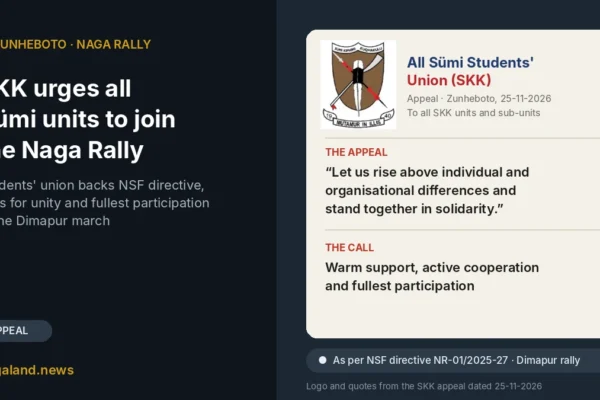
SKK Naga Rally appeal: Sümi students’ union urges all units to join Dimapur march
Backing the NSF directive, the All Sümi Students' Union has asked all its units and sub-units to rise…
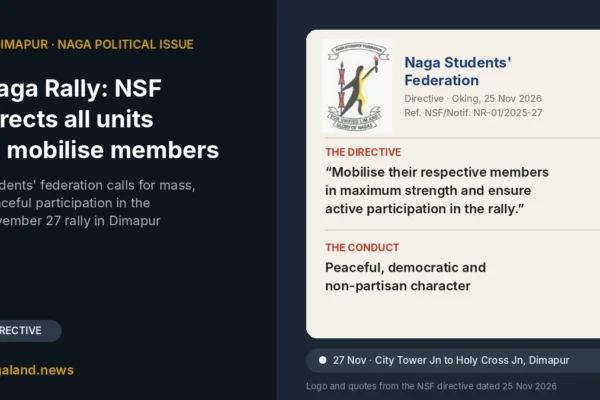
Naga Rally: NSF directs all units to mobilise members for Dimapur march on November 27
The Naga Students' Federation has told all its units to mobilise members in maximum strength for the November…
Rio meets Manipur CM Khemchand and Home Minister, calls for peace and reconciliation
Nagaland Chief Minister Neiphiu Rio held separate talks in Imphal with Yumnam Khemchand Singh and Konthoujam Govindas Singh,…
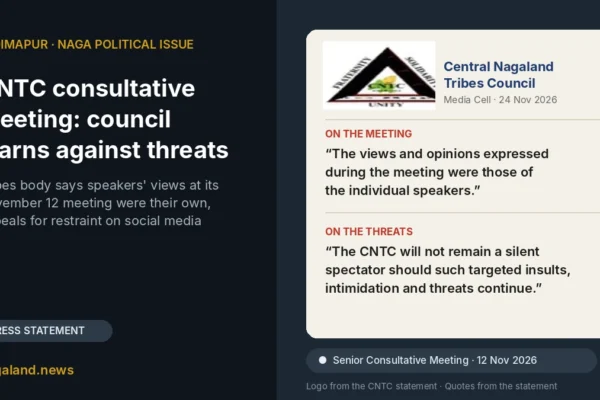
CNTC consultative meeting: Council says views were speakers’ own, warns against threats
The Central Nagaland Tribes Council says it did not endorse every view aired at its meeting on the…
Comments
No comments yet. Be the first to share your view.