
Child marriage in Nagaland: State cites 5.6% on UN day, but latest survey shows 10.2%
Social Welfare Secretary Limawabang Jamir quoted NFHS-5 data in Kohima; the newer NFHS-6 shows the share of young women married before 18 nearly doubled.
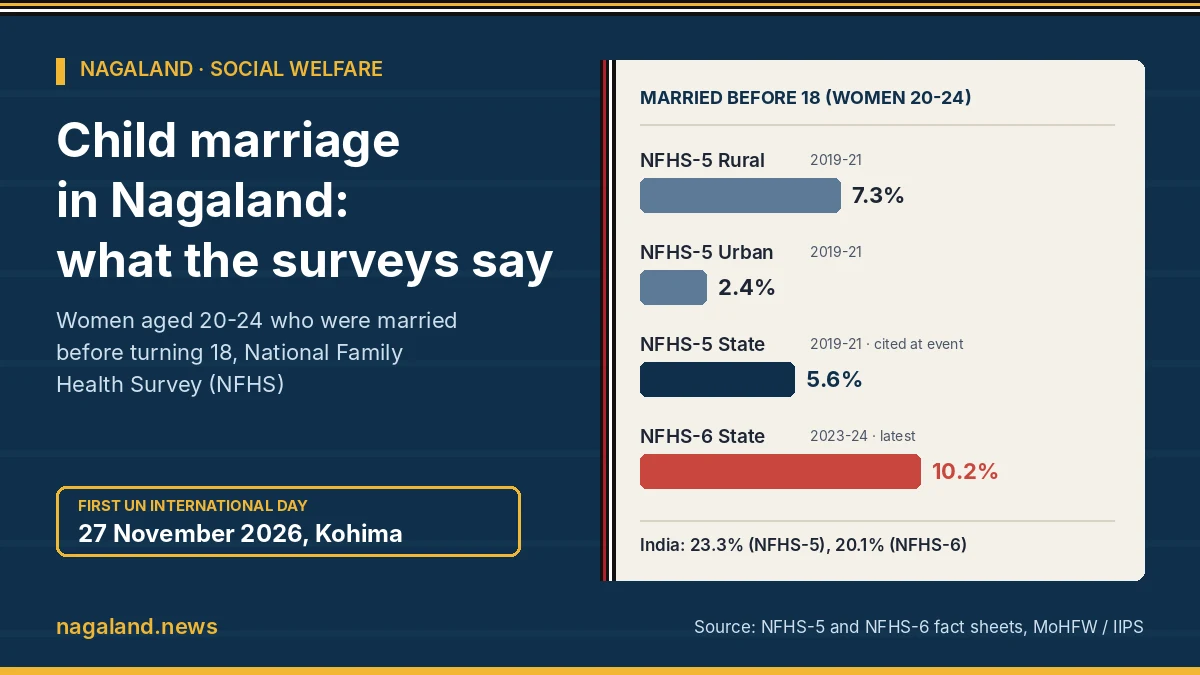
KOHIMA – The state’s top social welfare official put child marriage in Nagaland at 5.6 per cent on Friday, as Kohima marked the first International Day for the Elimination of Child, Early and Forced Marriage. But that figure comes from a survey conducted in 2019-21. The newer National Family Health Survey (NFHS-6), carried out in 2023-24, puts the share of young women in Nagaland who were married before 18 at 10.2 per cent, nearly double.
Social Welfare Secretary Limawabang Jamir, who delivered the keynote address at the Capital Convention Centre, flagged child marriage and teenage pregnancy as major concerns and called for sustained action at the community level. The event also heard a plan for a 100-day statewide awareness campaign against child marriage and child trafficking, running from 27 November 2026 to 8 March 2027.
What the Social Welfare Secretary said
Citing NFHS-5 (2019-21) data, Jamir said 5.6 per cent of women aged 20-24 in Nagaland had been married before turning 18. The rate was about three times higher in rural areas, at 7.3 per cent, than in urban areas, at 2.4 per cent, according to the official account of the programme released by the state’s Department of Information and Public Relations (DIPR).
He said Child Marriage Prohibition Officers (CMPOs) had been designated in all 17 districts, and that District Child Protection Units were running awareness programmes with schools and local communities. He added that the Beti Bachao Beti Padhao initiative under Mission Shakti was promoting girls’ education, tackling school dropouts and challenging discriminatory social norms.
According to the Press Trust of India, Jamir also said the Prohibition of Child Marriage Act, 2006, was still “under process” for formal adoption by the state government, but that its principles were being applied through departmental interventions. Under Article 371A of the Constitution, Acts of Parliament touching Naga customary law and social practices apply to Nagaland only if the state Assembly decides so.
Child marriage in Nagaland: what the newer NFHS-6 data shows
The NFHS-6 fact sheet for Nagaland, published by the Union Health Ministry and the International Institute for Population Sciences (IIPS), records that 10.2 per cent of women aged 20-24 were married before 18, up from 5.6 per cent in NFHS-5. The NFHS-6 fact sheets also show the rural-urban gap has narrowed sharply: 10.8 per cent in rural areas against 9.3 per cent in urban areas.
Among young men, the picture is similar. The share of men aged 25-29 who married before the legal age of 21 rose from 5 per cent in NFHS-5 to 10.2 per cent in NFHS-6.
The trend had earlier been downward. Child marriage in Nagaland fell from 13 per cent of women aged 20-24 in NFHS-4 (2015-16) to 5.6 per cent in NFHS-5, which then placed the state among the lowest in India. Nationally, the rate dropped from 23.3 per cent in NFHS-5 to 20.1 per cent in NFHS-6, so Nagaland remains well below the national average.
NFHS figures are sample-survey estimates, not counts of registered cases. The Social Welfare Department has not publicly explained the rise between the two surveys, and Friday’s programme did not refer to the NFHS-6 numbers.
Teenage pregnancy remains a concern
On teenage pregnancy, the latest data are slightly better. In NFHS-6, 3.2 per cent of women aged 15-19 in Nagaland were already mothers or pregnant at the time of the survey, down from 3.8 per cent in NFHS-5 and 5.7 per cent in NFHS-4. The rate in rural areas (4.2 per cent) is more than double that in towns (1.8 per cent).
Social Welfare Advisor Wangpang Konyak, the special guest, said child marriages in the state may not always be formally solemnised or reported, but pregnancies among very young girls, especially in rural areas, needed to be addressed alongside child marriage. He urged churches, faith-based organisations, tribal and community leaders, schools and NGOs to take part, saying ending the practice could not be the government’s job alone.
Official records show almost no cases. No case has been registered in Nagaland under the 2006 Act since the National Crime Records Bureau began publishing data on it. In October 2024, the Supreme Court questioned “zero case” reports from several states, including Nagaland, saying they could point to under-reporting rather than an absence of child marriage.
The 100-day campaign and what is not yet known
The programme outlined a statewide 100-day campaign from 27 November 2026 to 8 March 2027, aiming to reach one lakh people with awareness on child marriage and child trafficking. It set out five commitments: community responsibility, institutional accountability, protection of children at risk, empowerment through education and opportunities, and district-level action plans. It also stressed coordinated reporting, timely intervention, counselling, rehabilitation and continued schooling for affected children.
The plan was presented through the partner organisations Just Rights for Children and Prodigals’ Home. PTI described it as a proposal, with civil society, churches and village councils to take part. It is not yet clear whether the Social Welfare Department has formally adopted the campaign, who will fund it, or how its reach will be measured.
Separately, District Child Protection Units are holding awareness programmes from 1 to 30 November as part of the Centre’s ongoing 100-day Bal Vivah Mukt Bharat campaign, which runs from 21 October to 21 December 2026, Eastern Mirror reported.
Why 27 November
The United Nations General Assembly adopted a resolution by consensus on 4 September 2026 declaring 27 November the International Day for the Elimination of Child, Early and Forced Marriage. Sierra Leone led the resolution and India co-sponsored it. The date marks the anniversary of India’s Bal Vivah Mukt Bharat (Child Marriage-Free India) campaign, launched by the Union Ministry of Women and Child Development on 27 November 2024.
In India, the legal minimum age of marriage is 18 for women and 21 for men. Friday’s observance comes two days after the state began the 16 Days of Activism against gender-based violence in Kohima.
The Kohima programme was organised by Mission Vatsalya and Mission Shakti of the Social Welfare Department with Prodigals’ Home and Just Rights for Children. It was chaired by Additional Secretary and Mission Director, Mission Shakti, Olemjungla Aier. Dr Villo Naleo, Secretary for Social Concern at the Nagaland Baptist Church Council, said the invocation, and Akhonuo Pfusenuo of Bright Morning Star Children Home, Kohima, led the Bal Vivah Mukt Bharat pledge. A consultative meeting afterwards brought together the School Education and Health departments, Nagaland Police, the Nagaland State Legal Services Authority, the NBCC and civil society groups.

Aloto Naga
Aloto Naga is an Indian journalist and digital media entrepreneur based in Dimapur, Nagaland. He is the founder, editor and publisher of Nagaland.News (formerly Nagaland News Today), a digital publication covering breaking news, politics, education and community developments across Nagaland and Northeast India.
More about Aloto Naga →Related Stories
NTHCC backs Naga Rally, wants Charter of Demands made known to Nagas
The tribal hohos' committee wants the Charter of Demands and key understandings in the Naga talks made known…
Nagaland Police Hotel App: Hotels, homestays told to register guests ahead of Hornbill
Police cite security for the Hornbill Festival and festive season, and point to a 2025 ILP rule requiring…

Naga Rally in Dimapur: NSF asks why Centre has not delivered despite two accords
A public resolution at City Tower urged the Centre and Naga political groups to bring an inclusive and…
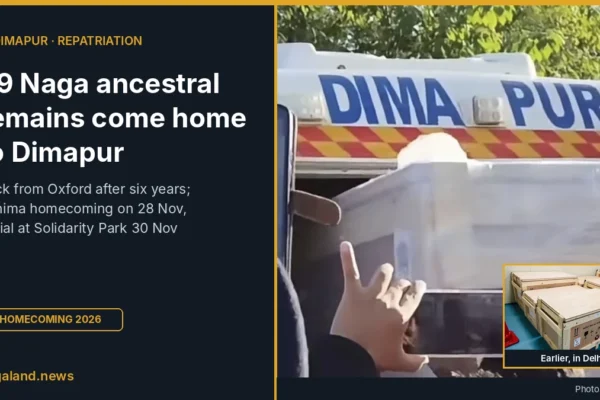
39 Naga ancestral remains come home to Dimapur after six years
Received in Dimapur six years after the repatriation process began, the remains will be honoured in Kohima before…
Comments
No comments yet. Be the first to share your view.